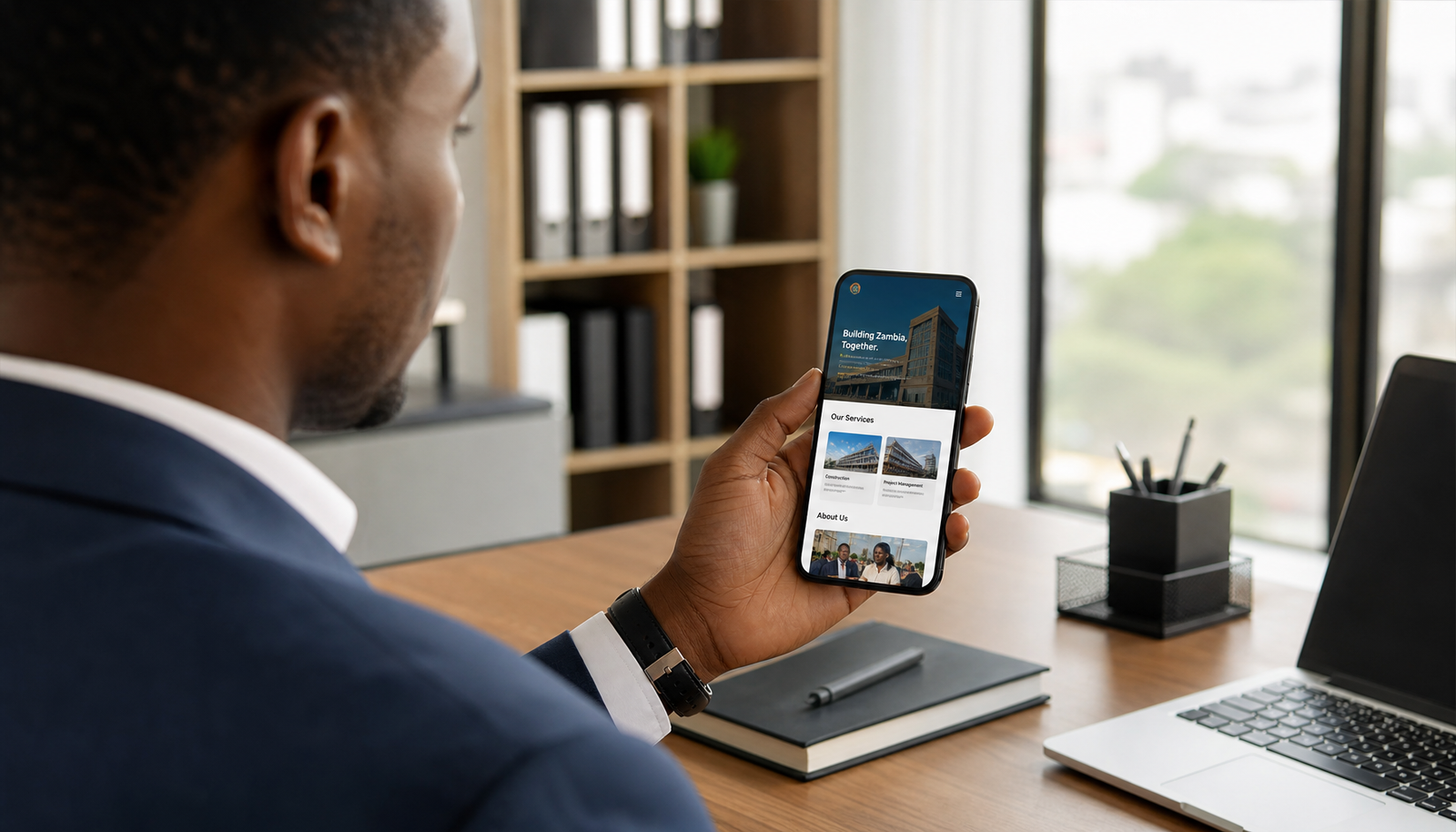
If your business does not have a Zambia mobile-friendly website, you are turning away the majority of your potential customers before they even read a single word about your products or services. With 92.1% of Zambians holding active cellular mobile connections as of early 2025 (per ZICTA, Zambia’s Information and Communications Technology Authority), the smartphone is not a secondary device for most people in Lusaka, Kitwe, Ndola, or Livingstone. It is the primary window to the internet. A website that does not work well on a small screen is not just inconvenient. It actively costs you enquiries, sales, and search visibility every single day.
This guide explains exactly why mobile responsiveness matters for Zambian businesses, what it means in plain language, and what practical steps you can take right now to fix or improve your site. Whether you run a retail shop on Cairo Road, a lodge near Livingstone’s Victoria Falls, a logistics firm in Ndola’s industrial area, or an online store serving all of Zambia, this applies to you.
By the end, you will know how to audit your current site, which design elements matter most, why Zambian mobile payment integration can make or break your checkout, and how to find the right developer to help.
The Mobile Reality in Zambia: What the Numbers Actually Mean
The 92.1% cellular connection figure from ZICTA is striking, but it needs context before you build a strategy around it. That number includes both smartphones and basic feature phones. Feature phones can browse simple pages but struggle with heavy JavaScript, large images, or complex navigation menus. Smartphones (running Android or iOS) represent a fast-growing share of that total, particularly among urban users in Lusaka, Kitwe, and the Copperbelt region, but not every Zambian yet carries a high-end device.
This has two practical implications for your website. First, your site must load fast even on a modest 3G connection, because 4G coverage, while expanding, is not yet universal across Zambia’s smaller towns and rural corridors. Second, your layout must work on small, lower-resolution screens, not just the latest flagship phones. A site built for a 27-inch desktop monitor and left untouched will break badly on a 5-inch budget Android phone, and that is the device most of your customers are holding.
I have seen Zambian business owners invest heavily in beautiful desktop websites, then wonder why their enquiry forms receive almost no submissions. The answer, nine times out of ten, is that the form is invisible or broken on mobile. The customers were there. The connection was there. The site just did not meet them where they were.
What “Responsive Design” Actually Means (No Jargon)
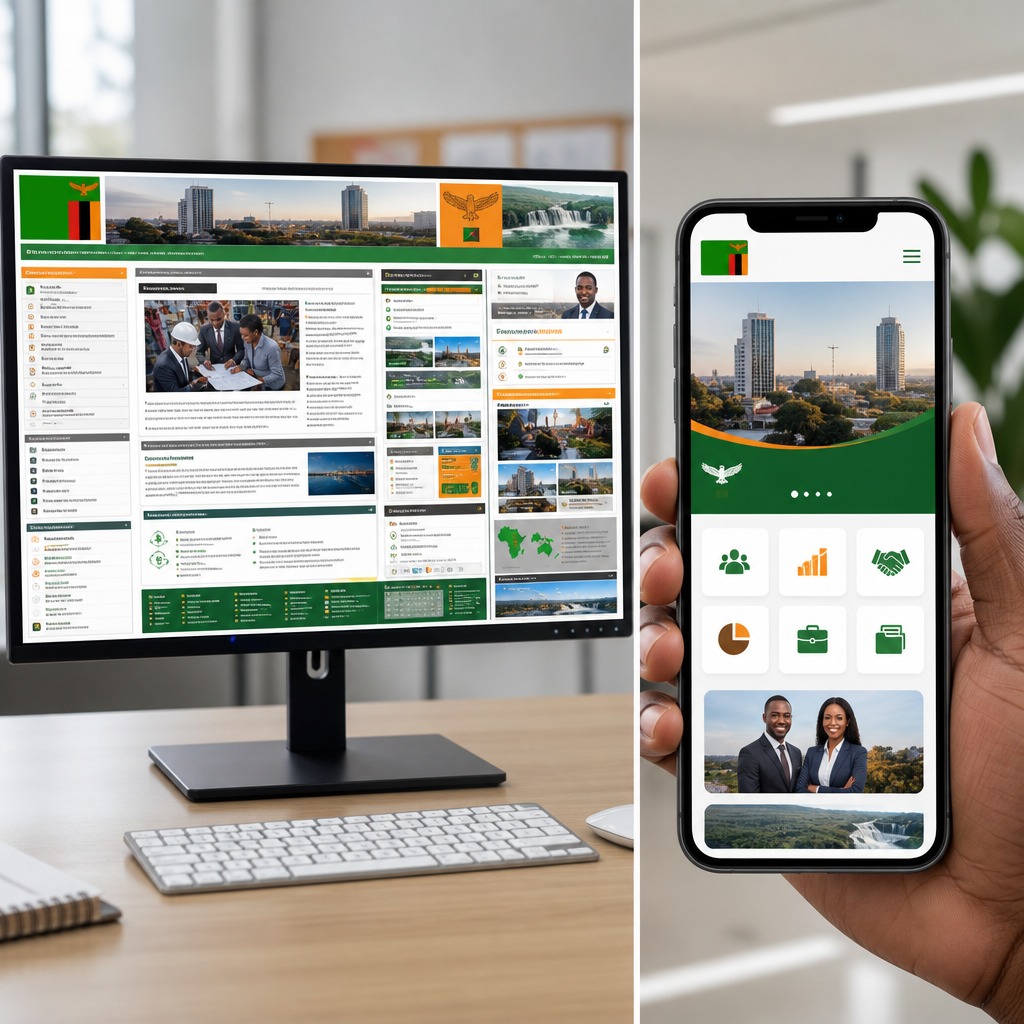
Responsive web design is simply a website that automatically adjusts its layout, text size, and images to fit whatever screen is viewing it, whether that is a desktop monitor, a tablet, or a mobile phone. You do not need a separate “mobile version” of your site. One site, built responsively, serves all devices correctly.
Think of it like water in a container. The water (your content) stays the same, but it takes the shape of whatever container (screen) holds it. A responsive site built by an experienced responsive website developer uses flexible layouts behind the scenes so that columns stack vertically on small screens, text stays readable without zooming, buttons become large enough to tap with a thumb, and images resize instead of overflowing off the edge.
The opposite of this is a fixed-width website. These were common in the early 2010s and are still surprisingly widespread among Zambian small business sites. They look fine on a laptop but become a nightmare on a phone, requiring users to pinch, zoom, and scroll sideways just to read a sentence. Most users simply leave instead of tolerating that experience.
How a Non-Mobile Site Hurts Your Zambian Business (With Real Scenarios)
Consider a guesthouse in Livingstone. A tourist in South Africa searches “budget accommodation near Victoria Falls” on their phone while planning a trip. Your site appears in the results, they tap the link, and the page loads with tiny, unreadable text and a booking form that is cut off on one side. They close the tab and book with a competitor whose site worked first time. That is a lost booking, possibly worth K1,500 or more, because of a design issue that a competent developer could fix in a week.
Or picture a hardware supplier in Ndola. A contractor on a construction site searches “roofing sheets supplier Ndola” on their Android phone between jobs. Your site loads, but the phone number is embedded in an image (so it cannot be tapped to call), the product catalogue PDF takes 45 seconds to download on a 3G signal, and the enquiry form requires 12 fields before submission. The contractor calls your competitor instead. Every week, this scenario plays out thousands of times across Zambia’s SME sector.
The cost of not having a mobile-friendly website in Zambia is not theoretical. It shows up as low enquiry volumes, high bounce rates (visitors who leave almost immediately), poor Google rankings, and lower revenue. These are measurable losses, not abstract risks.
Readable Text: The Starting Point of Mobile Usability
The first thing a visitor notices on a mobile page is whether they can read it without squinting or zooming. Good responsive design sets a base font size of at least 16 pixels for body text, with generous spacing between lines. Headings should be noticeably larger than body text but not so large that two words take up the full screen width.
Contrast matters as much as size. Light grey text on a white background is a common design choice that looks elegant on a large monitor but becomes nearly unreadable in Zambia’s bright outdoor sunlight, where many people use their phones. Dark text on a plain white or off-white background is almost always the right choice for readability across all conditions.
A web designer working on a mobile website design in Lusaka for a financial services firm told me they cut their bounce rate by 28% simply by increasing body font size and improving text contrast, before touching anything else on the site. Those two changes alone made the content readable for the majority of phone users visiting on sunny days outdoors.
Touch-Friendly Controls: Buttons, Menus, and Links
A mouse cursor is precise to a single pixel. A human thumb is not. Buttons, links, and form fields on a mobile site must be large enough to tap accurately without accidentally hitting the wrong element. Google recommends a minimum tap target size of 48 by 48 pixels for interactive elements, which is roughly the size of a standard fingertip area.
Navigation menus present a specific challenge. Desktop sites often use multi-level dropdown menus that are triggered by hovering a mouse over a category. On a touchscreen, there is no “hover” state. Those menus either do nothing or behave unpredictably when tapped. A well-built responsive site replaces complex dropdowns with a simple “hamburger” menu (three horizontal lines) that expands cleanly when tapped, revealing clearly separated menu items with enough spacing between each one.
Call-to-action buttons, such as “Get a Quote,” “Call Us Now,” or “Add to Cart,” should stand out visually and be placed where a thumb can reach them easily, typically near the centre or bottom of the screen rather than tucked into a top corner. On a phone number displayed on a mobile site, the number should be a clickable link so tapping it immediately dials. This is called a “tel:” link and takes a developer about two minutes to add, yet many Zambian business sites still miss it.
Fast Images and Page Speed on Zambian Networks
Page speed is one of the most direct drivers of whether a mobile visitor stays or leaves. Research from Google consistently shows that as page load time increases from one second to three seconds, the probability of a visitor leaving jumps by 32%. On slower mobile networks, which remain common in parts of Zambia outside major urban centres, even a three-second load time requires effort to achieve.
The biggest culprit is almost always images. A photographer in Livingstone might upload stunning, high-resolution portfolio shots straight from their camera, each image weighing 8 to 12 megabytes. On a 3G connection, a single image like that can take over a minute to load. The fix is straightforward: compress images to a reasonable file size (usually under 150 kilobytes for most web images) and use modern image formats like WebP that deliver better quality at smaller sizes.
Your developer can also set up your site to serve smaller image versions to smaller screens automatically, so a phone does not waste data downloading an image sized for a widescreen monitor. This alone can cut page weight by 50% or more on mobile devices. For an e-commerce store in Kitwe selling clothing or electronics, faster product images directly translate to more completed purchases. Combined with removing unnecessary scripts and plugins, a competent developer can often get a Zambian SME site loading in under two seconds on a 4G connection, which is a realistic target for most urban users.
Zambian Mobile Payment Integration: The Checkout Factor Most Sites Get Wrong
This section is the most commercially important one in this entire guide, so read it carefully. A mobile-optimised layout means nothing if your customer reaches the checkout page and cannot pay using the method they trust and already have on their phone.
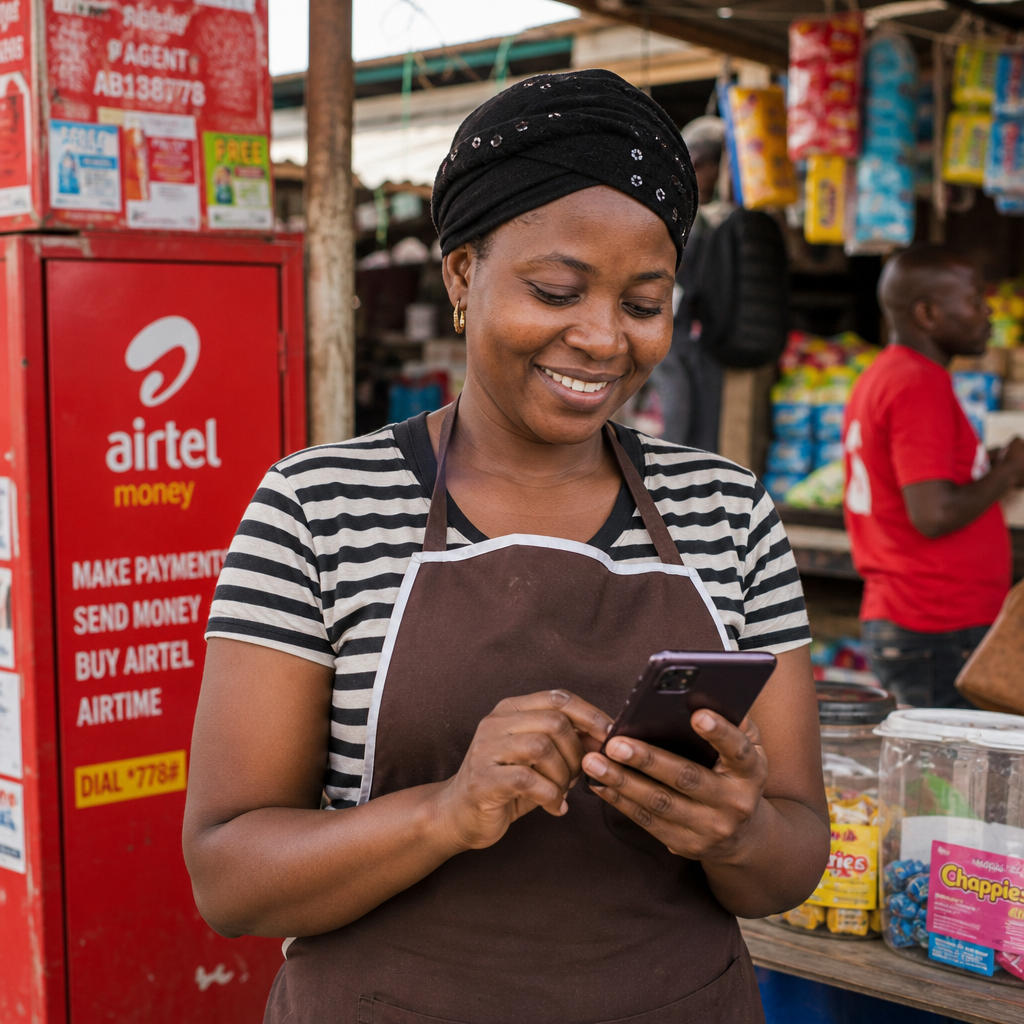
In Zambia, the dominant mobile payment systems are Airtel Money, MTN Mobile Money, and Zamtel Kwacha. These services have millions of active users across Zambia, including in areas where people do not hold traditional bank accounts or credit cards. If your ecommerce mobile Zambia store only accepts Visa or bank transfers at checkout, you are excluding a large portion of your potential customers immediately.
I have spoken with Zambian online retailers who added Airtel Money integration to their checkout and saw mobile transaction volumes double within two months. The reason is simple: customers already have the app on their phone, the funds in their wallet, and the trust in the system. Asking them to instead enter a 16-digit card number on a small screen, find their card’s CVV, and wait for a 3D Secure SMS introduces enough friction that many abandon the cart entirely.
Here is what this means practically for your business. If you are building or redesigning a website with an online shop, brief your developer to integrate at least one local mobile money gateway alongside any card payment option. Several Zambian payment aggregators offer APIs (technical connection tools) that handle Airtel Money, MTN Mobile Money, and Zamtel Kwacha together through a single integration. Your developer will know the options, but you should ask for this explicitly. It is not always included by default. For businesses in Kitwe or Ndola serving customers across the Copperbelt, local mobile money acceptance can be the single biggest lever for increasing mobile sales.
Simple Forms: Fewer Fields, More Submissions
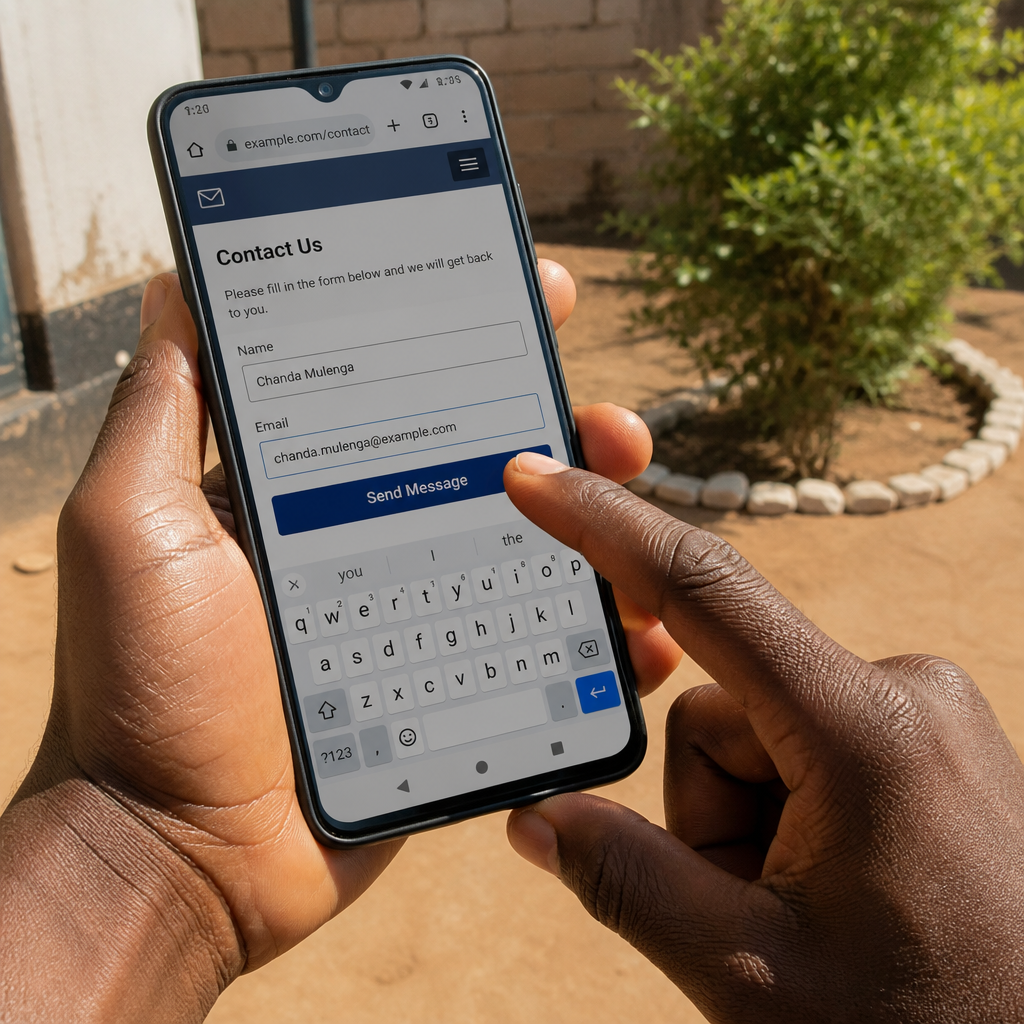
Enquiry and contact forms are the primary conversion tool for most Zambian service businesses, from law firms in Lusaka to tour operators in Livingstone. On desktop, a form with eight fields might feel reasonable. On mobile, scrolling through eight fields, switching between keyboard types, and accurately tapping small input boxes creates enough friction to significantly reduce the number of people who complete the form.
Studies on form conversion rates consistently show that reducing a form from more than four fields to three or fewer can increase submission rates by 50% or more, a finding supported by data from Nielsen Norman Group, one of the most widely cited authorities on user experience research. For Zambian businesses, the practical recommendation is to collect only the information you genuinely need to follow up: typically a name, phone number or email, and one line about the enquiry. Everything else can be gathered during the follow-up call or email.
Forms on mobile should also use the correct keyboard type for each field. A phone number field should trigger the numeric keypad. An email field should show the keyboard with the “@” symbol prominent. These settings take a developer a few minutes to configure but make a real difference to how easy it feels to fill in the form on a phone. A cleaning company in Ndola I worked with cut their contact form from nine fields to four and saw monthly enquiries increase by 40% over the following quarter, without changing anything else on the site.
How Mobile-Friendliness Directly Affects Google Search Rankings in Zambia
Google moved to what it calls “mobile-first indexing” as the default for all websites. This means Google’s systems primarily use the mobile version of your site, not the desktop version, to decide how to rank you in search results. If your mobile site is slow, hard to navigate, or missing content that appears on your desktop version, your search rankings suffer for everyone, including desktop users.
For Zambian businesses competing for local search terms like “web design Lusaka,” “hotel Livingstone,” or “logistics company Ndola,” this is a direct ranking factor. A responsive web design in Zambia that passes Google’s mobile usability checks will rank better than a non-responsive competitor, all else being equal. Google also uses page speed as a ranking signal, which reinforces the importance of fast-loading images and lean code.
There is also a local search dimension. When someone in Kitwe searches “plumber near me” on their phone, Google serves results it believes are geographically relevant and technically credible. A mobile-friendly site with accurate business information (address, phone number, operating hours) signals credibility. A broken, slow mobile experience signals the opposite, and Google’s algorithm interprets it accordingly.
For any business serious about its digital presence in Zambia, mobile search optimisation is not a technical nicety. It is the foundation of being found online at all.
Mobile Website Audit Checklist for Zambian Businesses
Use this checklist to assess your current website. You can run most of these checks yourself in under 30 minutes. Where you find problems, note them to share with your developer.
- Google Mobile-Friendly Test: Visit Google’s Mobile-Friendly Test tool, enter your URL, and check whether Google rates your site as mobile-friendly. This is the single most important first step.
- Page speed check: Visit Google PageSpeed Insights, enter your URL, and note the mobile score. Aim for a score above 70. Below 50 is a problem that needs urgent attention.
- Text readability: Open your site on your own smartphone without zooming. Can you read every paragraph comfortably? If you need to pinch to zoom, the font size is too small.
- Button and link tap targets: Try tapping every button, link, and menu item on your phone. Do any require multiple attempts to hit accurately? Are any too close together?
- Navigation test: Can you find the contact page, main product or service page, and pricing information within three taps on a phone? If not, your navigation needs simplifying.
- Form usability: Fill in your own contact or enquiry form on a mobile phone. Does each field trigger the right keyboard type? Are all fields visible and easy to tap? How many fields does the form have?
- Phone number tap-to-call: Tap your displayed phone number on a mobile phone. Does it immediately prompt a call? If not, it needs to be set up as a clickable link.
- Image load time: On a standard mobile data connection (not your office Wi-Fi), time how long your homepage takes to fully load. Over four seconds is a problem for most users.
- Mobile payment options: If you sell online, does your checkout offer Airtel Money, MTN Mobile Money, or Zamtel Kwacha? If not, you are missing a significant share of potential transactions.
- Cross-device test: View your site on at least two different phones if possible. A site that looks fine on a Samsung Galaxy might break on a cheaper Tecno or Itel device with a smaller screen.
Do This Today: A Short Action List for Budget-Conscious Owners
If you are a small business owner in Zambia working with a limited budget, here is where to start right now without spending anything.
- Run the Google Mobile-Friendly Test on your site today. Save the result as a screenshot. If it fails, share the screenshot with your current developer or use it as a brief when approaching a new one.
- If you are building a new site on a tight budget, consider platforms like WordPress with a responsive theme, Wix, or Shopify. All three produce mobile-responsive output by default and do not require a deep technical background to manage. A professional web design service in Zambia can set these up for you quickly and affordably.
- Ask any developer you hire one direct question: “Will this site score above 70 on Google PageSpeed Insights for mobile?” A good developer will answer yes and explain how. If they seem uncertain or dismissive, treat that as a signal.
- Check that your site displays your phone number as a tappable link. This is a five-minute fix with genuine impact on enquiry volumes.
- If you run an online shop, ask your developer this week about adding an Airtel Money or MTN Mobile Money payment option. Even a single local mobile payment method can meaningfully increase completed orders.
Choosing the Right Responsive Website Developer in Zambia
Not every web designer who advertises services in Zambia delivers genuinely responsive, fast-loading sites. Here is what to look for when evaluating a developer or agency.
Ask to see examples of their recent work and test those examples on your own phone before agreeing to anything. Run the sites through Google’s Mobile-Friendly Test and PageSpeed Insights. If the developer’s own portfolio sites fail basic mobile tests, that tells you everything you need to know about the quality of work they produce for clients.
Ask specifically whether they build mobile-first or whether mobile is an afterthought they address at the end of a project. The best developers design for the smallest screen first and scale up to desktop, because it forces better decisions about content priority and load speed from the very beginning.
Also ask about ongoing support. A responsive website design in Zambia is not a one-time project. Phones change, screen sizes evolve, and new operating system updates can occasionally break elements that worked before. A developer who offers a maintenance arrangement or at least responds to reported issues promptly is worth the investment. Our web design services include post-launch support specifically because we see how much this matters for Zambian SMEs operating without in-house technical staff.
For businesses with existing sites, a responsive redesign does not always mean starting from scratch. An experienced developer can often update an existing site’s theme or template to be responsive while keeping your content, branding, and domain intact. This is typically faster and less expensive than a full rebuild, and it is worth asking for a scoped assessment before committing to a larger project.
The Business Case: What Improved Mobile Experience Delivers
Across the businesses I have seen go through a mobile-first redesign in Zambia and across Africa more broadly, the outcomes follow a consistent pattern. Bounce rates (the percentage of visitors who leave after one page) typically fall by 20 to 40%. Enquiry form submissions increase. For e-commerce sites, cart abandonment rates drop, particularly when local mobile payment options are added at the same time.
Search rankings improve within weeks to months, depending on how significant the previous mobile issues were and how competitive the keywords are. Businesses that previously ranked on page two or three for their target terms often move to page one after a responsive rebuild combined with basic on-page SEO. For a tourism operator in Livingstone or a supplier in Kitwe, that ranking difference can represent hundreds of new visitors per month from people actively looking for exactly what the business offers.
Perhaps the most underappreciated benefit is customer trust. A mobile site that works properly communicates professionalism. It signals that the business cares about its customers’ experience. In markets where formal quality signals are fewer than in more developed economies, a clean, fast, easy-to-use mobile website is a genuine competitive differentiator. Many of your competitors in Lusaka, Ndola, or Livingstone still have not made this investment. That is an opportunity, and it is available right now to any business willing to act on it.
If you are ready to improve your mobile responsiveness in Zambia or need a full website redesign that works beautifully on every device, explore our responsive web design packages built specifically for Zambian businesses. We also offer a free initial site review for businesses that want an honest assessment of where they currently stand before committing to any project.
Key Takeaways
- Over 92% of Zambians have cellular mobile connections, making the smartphone the primary internet access device across the country, from Lusaka to Livingstone.
- A Zambia mobile-friendly website is not a luxury feature. It is the baseline requirement for being competitive in any sector that serves Zambian consumers.
- Responsive design means one website that automatically adjusts to fit any screen, no separate mobile site needed.
- Airtel Money, MTN Mobile Money, and Zamtel Kwacha integration at checkout is the single highest-impact change an e-commerce site can make for Zambian mobile users.
- Readable text, touch-friendly buttons, fast images, and short forms are the four practical pillars of mobile usability.
- Google’s mobile-first indexing means poor mobile performance directly lowers your search rankings for all users, not just mobile visitors.
- Use the Google Mobile-Friendly Test and PageSpeed Insights today to get an objective picture of where your site stands.
- The right responsive website developer will build mobile-first, deliver fast load times, and include local payment integration by default.
Conclusion
The Zambian internet audience is a mobile audience. Whether your customers are in Lusaka’s central business district, on the Copperbelt in Kitwe or Ndola, or heading to a safari lodge near Livingstone, they are reaching for their phones first. A Zambia mobile-friendly website that loads fast, reads clearly, accepts local payments, and guides visitors toward an enquiry or purchase is one of the highest-return investments a Zambian business can make right now.
The checklist above gives you a starting point you can use today, at no cost, to see exactly where your current site stands. If you find gaps, you now know what to prioritise and what to ask for when you engage a developer.
Take the first step today: run your site through the Google Mobile-Friendly Test and note what it tells you. Then reach out to our team for a free site review. We work with businesses across Zambia to build responsive, fast, conversion-focused websites that perform where your customers actually are, on their phones.
FAQ
What does 'mobile-friendly website' mean for a Zambian business?
A mobile-friendly website automatically adjusts its layout, text size, and images to display correctly on smartphones and tablets. For Zambian businesses, this means customers in Lusaka, Kitwe, Ndola, or Livingstone can read your content, tap your buttons, and fill in your forms without zooming or scrolling sideways on their phones.
How many Zambians browse the internet on mobile phones?
According to ZICTA, Zambia's Information and Communications Technology Authority, 92.1% of the total population held active cellular mobile connections in early 2025. This includes both smartphones and feature phones, with smartphones being the dominant device for internet browsing among urban users across the Copperbelt and Lusaka.
Does my website's mobile performance affect my Google ranking in Zambia?
Yes, directly. Google uses mobile-first indexing, meaning it ranks websites based primarily on their mobile version. A slow, hard-to-use mobile site will rank lower in Zambian search results than a responsive, fast-loading competitor site, even for people searching on desktop computers.
Which mobile payment options should my Zambian e-commerce site support?
Your checkout should support Airtel Money, MTN Mobile Money, and Zamtel Kwacha at a minimum. These are the most widely used mobile payment systems in Zambia. Many customers do not hold credit cards but actively use mobile money wallets, so excluding these options will significantly reduce your completed mobile transactions.
How can I test whether my current website is mobile-friendly?
Visit Google's Mobile-Friendly Test at search.google.com/test/mobile-friendly and enter your website address. The tool gives you an immediate pass or fail result plus specific issues to fix. Also run your URL through Google PageSpeed Insights at pagespeed.web.dev to check your mobile load speed score.
What is the most common reason mobile visitors leave a Zambian business website quickly?
The most common reasons are slow page load times (caused by oversized images and heavy scripts on slower 3G or 4G connections), text that is too small to read without zooming, and buttons or links that are too small to tap accurately. Fixing these three issues typically reduces bounce rates significantly within weeks.
How much does a responsive website redesign cost for a small business in Zambia?
Costs vary depending on the scope, the number of pages, and whether e-commerce functionality is required. Many Zambian SMEs opt for platforms like WordPress, Wix, or Shopify with a responsive theme, which can be set up by a local developer at a relatively low cost. Contact a web design service for a scoped assessment before committing to a budget.