Choosing the wrong e-commerce platform can cost a Zambian business thousands of kwacha in lost sales, wasted developer hours, and payment integration headaches. Shopify vs WooCommerce is the most important decision you will make before launching an online store in Zambia, and the right answer depends on your budget, technical ability, and which payment gateways you need on day one.
According to AfterShip’s 2026 platform market share data, WooCommerce powers 63.14% of online stores in Zambia, while Shopify accounts for 16.77%. Those numbers tell a story, but they are not the whole story. This guide breaks down every dimension that matters for a Zambian SMB, from ZMW-denominated costs and MTN Mobile Money activation to hosting options and scalability.
By the end, you will have a concrete recommendation for your situation, plus three actions you can take today to move forward.
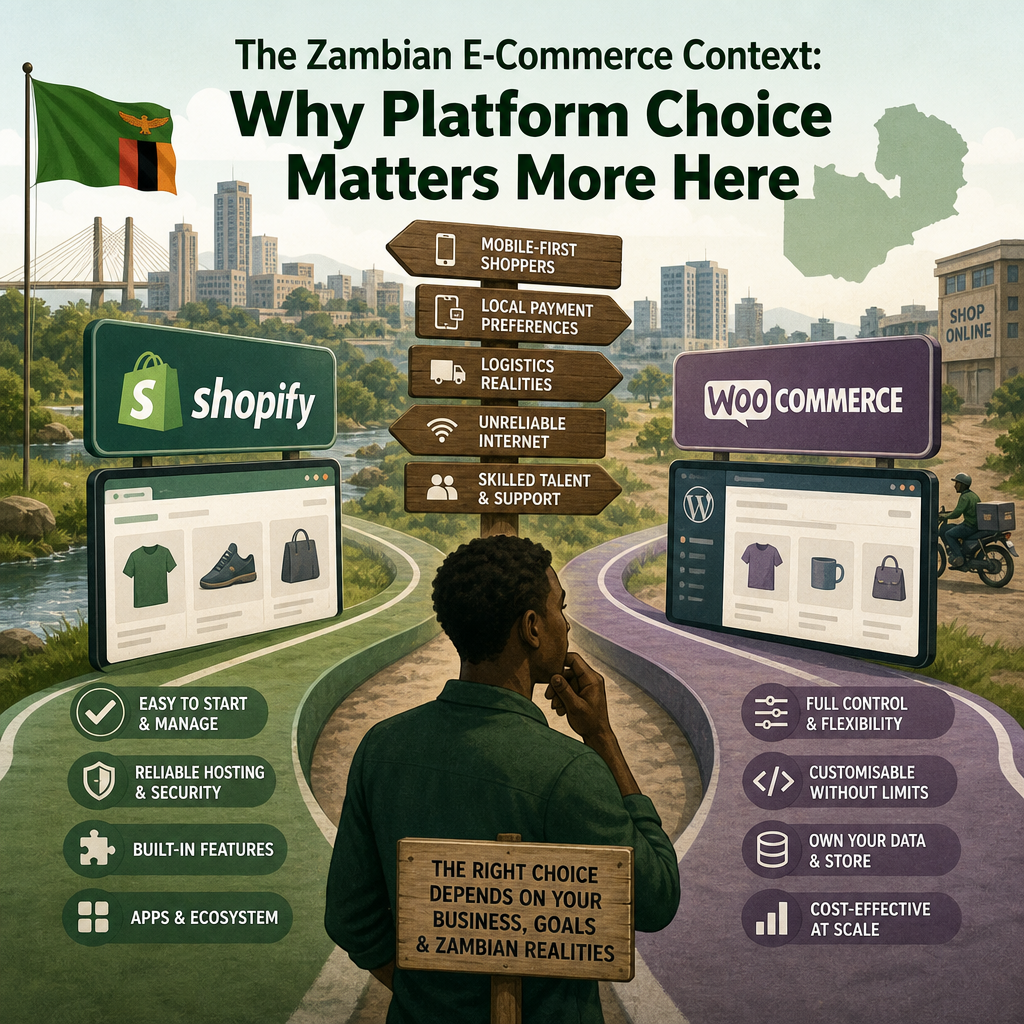
The Zambian E-Commerce Context: Why Platform Choice Matters More Here
Zambia’s e-commerce market is projected to reach USD 569.10 million by 2029, growing at 7.94% annually between 2024 and 2029, according to market research compiled by InfoBwana’s Zambia e-commerce outlook. Mobile money is the dominant payment rail, not credit cards. MTN Mobile Money and Airtel Money together serve millions of Zambians who have never owned a Visa card.
This single fact changes every comparison you read from a global perspective. A platform that handles Stripe payments beautifully but cannot accept MTN Mobile Money is essentially useless for most Zambian customers. Local payment integration is not a nice-to-have feature here. It is the core requirement your platform must meet on launch day.
Shopify vs WooCommerce: Side-by-Side Overview
Before going deep on individual dimensions, here is a plain-language summary of what each platform actually is.
Shopify is a hosted SaaS (Software as a Service) platform. You pay a monthly subscription and Shopify manages the server, security, software updates, and uptime. You do not need a hosting account. Everything lives inside Shopify’s ecosystem.
WooCommerce is a free, open-source plugin that runs on top of WordPress. You own the software, but you are responsible for buying hosting, installing WordPress, keeping everything updated, and managing security. The plugin itself costs nothing. The surrounding infrastructure does.
Ownership and Control
With Shopify, you are renting a fully managed store. Shopify owns the platform and can change pricing, remove features, or discontinue plans with notice. Your data is exportable, but your store cannot run anywhere except Shopify’s servers. This is a genuine trade-off, not just a theoretical risk.
With WooCommerce, you own the WordPress installation, the database, the theme, and every plugin. If your hosting provider shuts down, you move the files to a new server and the store keeps running. For Zambian businesses that have experienced unreliable third-party services, this level of control can be genuinely reassuring.
Verdict: WooCommerce wins on ownership. Shopify wins on simplicity and zero server maintenance.
Monthly Costs in ZMW: The Full Picture
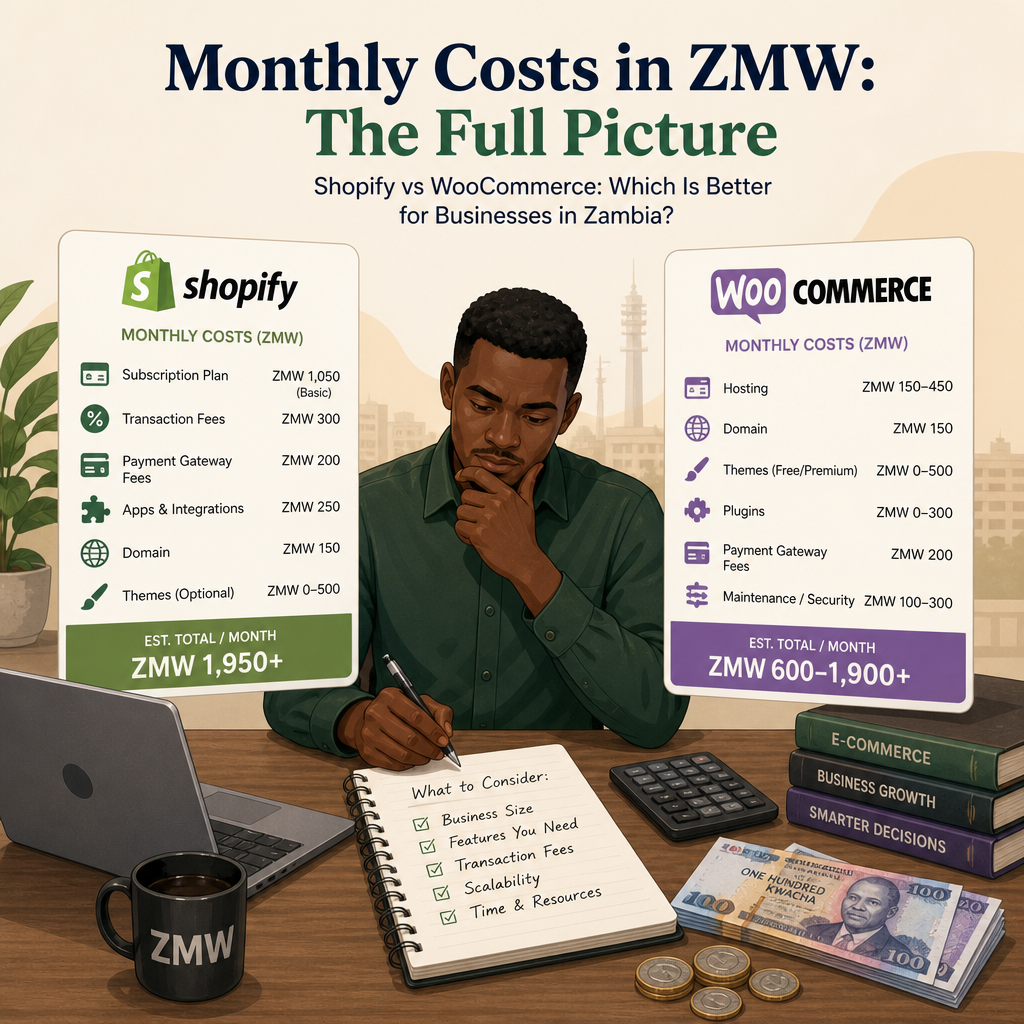
Global cost comparisons almost always quote USD. Below, costs are converted at approximately ZMW 27 per USD (the approximate mid-market rate as of mid-2025 – verify the current rate at the Bank of Zambia before making budget decisions, as the kwacha fluctuates). All figures are estimates to help with planning, not locked pricing.
Shopify Costs (ZMW per month)
- Basic plan: USD 39/month = approx. ZMW 1,053/month
- Shopify plan: USD 105/month = approx. ZMW 2,835/month
- Advanced plan: USD 399/month = approx. ZMW 10,773/month
- Transaction fee (Basic, using external payment gateway): 2% per sale
- Transaction fee (Shopify plan): 1% per sale
- Transaction fee (Advanced): 0.5% per sale
- Domain name: approx. USD 14/year = ZMW 378/year
Zambia Warning – Transaction Fee Drag: A Zambian SMB processing ZMW 15,000/month through Shopify Basic with a third-party gateway (such as Pesapal) pays 2% in Shopify transaction fees = ZMW 300/month, or ZMW 3,600/year, on top of any fees the gateway itself charges. On the Shopify plan, that drops to ZMW 150/month. This is separate from Shopify Payments, which is not available in Zambia as of 2025. Every Zambian store owner must use an external gateway, which means transaction fees apply at every tier except Advanced on certain gateways.
WooCommerce Costs (ZMW per month)
- WooCommerce plugin: Free (ZMW 0)
- WordPress hosting – shared (e.g., Bluehost, SiteGround): approx. USD 5-15/month = ZMW 135-405/month
- WordPress hosting – managed WordPress (e.g., Kinsta, WP Engine): approx. USD 35-115/month = ZMW 945-3,105/month
- Domain name: approx. USD 12-14/year = ZMW 324-378/year
- Premium theme (one-time): approx. USD 50-80 = ZMW 1,350-2,160
- Paid plugins (security, backup, SEO): approx. USD 10-40/month = ZMW 270-1,080/month
- Transaction fees: Determined by the payment gateway only – no platform-level fee
Zero-Budget WooCommerce Path for Bootstrapped Zambian Founders
If you have near-zero capital, WooCommerce on shared hosting is achievable for under ZMW 200/month. Use the free Storefront theme (maintained by the WooCommerce team), the free Wordfence Security plugin, and UpdraftPlus free for weekly backups. Install Pesapal or DPO Group’s free WooCommerce plugin for payments. This path requires more of your time than your money, but it is a real path.
Shopify has no equivalent zero-budget option. The lowest plan is USD 39/month regardless of whether you make any sales.
Hosting: What Zambian Businesses Actually Need
Shopify handles hosting entirely. Their infrastructure targets 99.99% uptime and uses global CDN delivery. You do not think about servers. This is particularly valuable if your team has no technical staff and you cannot afford downtime during peak sales periods like Black Friday or end-of-month salary paydays in Zambia.
WooCommerce requires you to choose and manage your own host. For Zambian businesses targeting local customers, latency matters. A server based in Europe or the US can add 300-800ms of load time for a Lusaka visitor, which hurts conversion rates on mobile connections.
Hosting verdicts for WooCommerce in Zambia:
- Bluehost or SiteGround (shared): Acceptable for stores under 500 products and low traffic. Use their closest data centre (Bluehost uses US, SiteGround uses London for African proximity). Good for bootstrapped launches.
- Kinsta or WP Engine (managed WordPress): Recommended for stores expecting consistent daily traffic. They handle updates, caching, and security automatically. Faster support. Higher cost.
- Cloudflare (free CDN layer on top of any host): Add this regardless of host. It reduces load times for Zambian visitors by caching content at Cloudflare’s Johannesburg node.
Ease of Use
Shopify is genuinely beginner-friendly. You create an account, choose a theme, add products, connect a payment method, and go live. The admin panel is clean and logical. A non-technical business owner in Kitwe or Livingstone can set up a basic store in a weekend without hiring a developer.
WooCommerce has a steeper learning curve. You first need to install WordPress, then install WooCommerce, configure permalinks, set up SSL, and understand the plugin ecosystem before you can add your first product. Most Zambian business owners benefit from at least a few hours of developer help during the initial setup, even if they plan to manage the store themselves afterward.
Verdict: Shopify wins clearly for non-technical founders. WooCommerce is manageable for those willing to invest setup time or hire a local developer for the initial configuration.
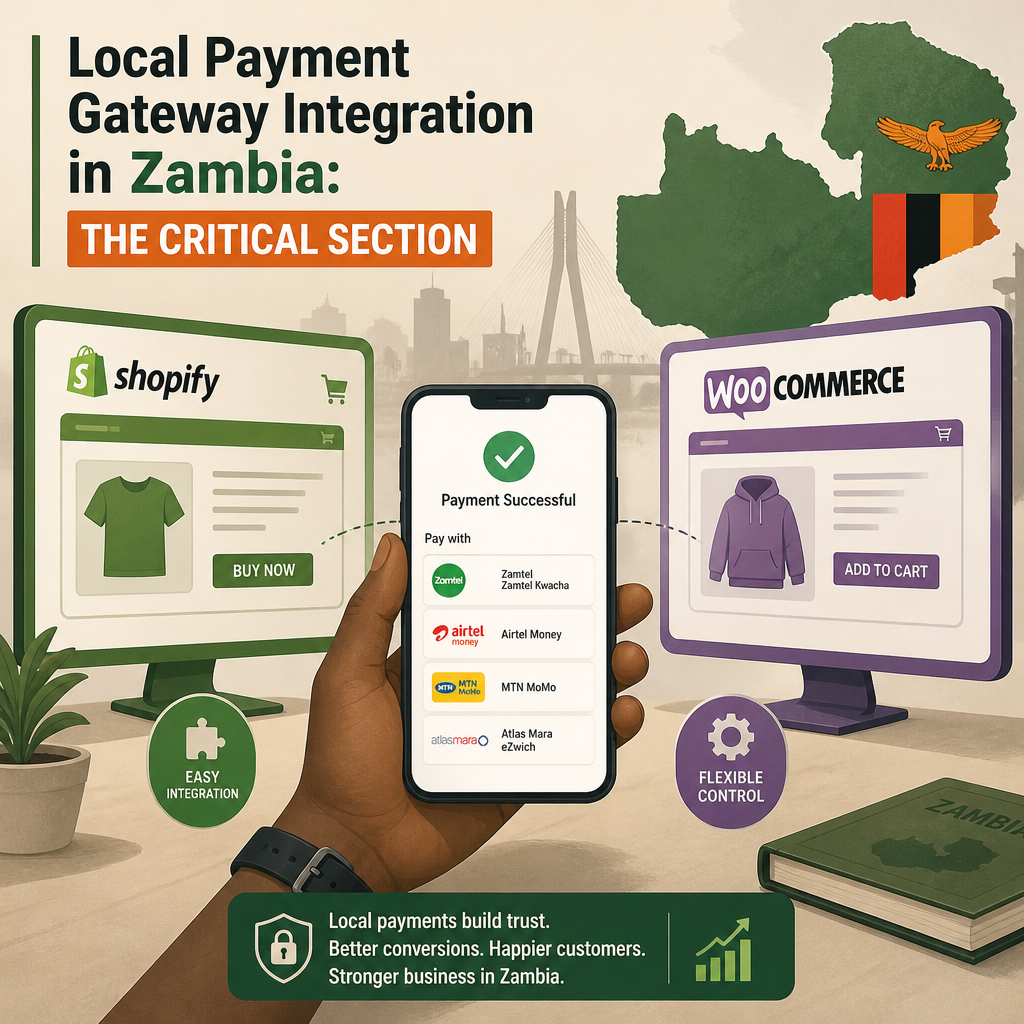
Local Payment Gateway Integration in Zambia: The Critical Section
This is where most global guides fail Zambian readers. Below are concrete activation walkthroughs for MTN Mobile Money and Pesapal on both platforms.
MTN Mobile Money on WooCommerce
Plugin name: Use the “MTN Mobile Money Payment Gateway for WooCommerce” plugin, or integrate via a payment aggregator plugin that includes MTN MoMo (such as DPO Group’s WooCommerce plugin or Pesapal’s WooCommerce plugin, both of which bundle MTN MoMo alongside card payments).
Steps to activate:
- Register a business account with MTN Zambia’s Mobile Money merchant portal. Go to an MTN Zambia business centre in Lusaka (Cairo Road or Levy Junction) with your PACRA business registration certificate, company bank account details, and director’s national ID. MTN requires the PACRA certificate before approving merchant status.
- MTN will issue you an API key, a Subscription Key, and a Callback URL endpoint. Approval typically takes 5-14 business days.
- Install your chosen WooCommerce plugin from the WordPress admin (Plugins > Add New). Search for “DPO Group” or “Pesapal” and install the official plugin.
- Go to WooCommerce > Settings > Payments and enable the MTN MoMo option. Enter your API credentials from step 2.
- Run a test transaction of ZMW 1 from a personal MTN line before going live.
Zambian business registration dependency: MTN Zambia will not issue merchant API credentials to unregistered businesses. You must have a PACRA certificate (sole trader or limited company). If you are operating informally, sort the registration first. PACRA online registration typically costs ZMW 450-600 and takes 3-7 working days.
Realistic approval timeline: PACRA registration (3-7 days) + MTN merchant account approval (5-14 days) + developer integration and testing (1-3 days) = plan for 2-4 weeks from start to first live transaction.
MTN Mobile Money on Shopify
Shopify does not have a direct MTN MoMo plugin in its App Store for Zambia as of 2025. The practical route is to integrate via a payment aggregator that supports MTN MoMo and has a Shopify app or manual payment gateway option.
Steps to activate via Pesapal:
- Register a Pesapal merchant account at pesapal.com. You will need your PACRA certificate, business bank account details, and a phone number registered to the business. Pesapal operates in Zambia and supports MTN Mobile Money, Airtel Money, Visa, and Mastercard through a single integration.
- Pesapal reviews merchant applications within 3-7 business days.
- In your Shopify admin, go to Settings > Payments > Manual Payment Methods. Add a custom payment method titled “Pay via MTN Mobile Money / Pesapal.” Paste your Pesapal payment link or embed their hosted payment page URL.
- Alternatively, search the Shopify App Store for “Pesapal” to find any current app listing. If an official app exists at the time you are reading this, install and configure it with your Pesapal merchant ID and API credentials.
- Test with a ZMW 1 transaction before opening to customers.
Important limitation: Shopify’s native checkout is optimised for card-based payments. Adding MTN MoMo via a manual method or redirect creates a slightly clunkier checkout experience compared to WooCommerce, where a native plugin can display the MoMo payment form inline. This is a real UX disadvantage for Shopify in the Zambian market.
Realistic timeline on Shopify: PACRA registration (3-7 days) + Pesapal approval (3-7 days) + Shopify configuration (half a day) = plan for 1-3 weeks.
Pesapal Integration Comparison
Pesapal is arguably the most practical all-in-one gateway for Zambian stores because it handles MTN MoMo, Airtel Money, Visa, Mastercard, and bank transfers through one merchant account. On WooCommerce, the official Pesapal plugin creates a fully embedded checkout experience. On Shopify, you work through a redirect or manual payment method unless an official Shopify app is available.
Merchant account requirements for Pesapal (both platforms): PACRA certificate, business bank account (Zanaco, Stanbic, FNB Zambia, Absa, or similar), directors’ IDs, and a Zambian phone number. Sole traders can apply. Approval takes 3-7 business days on average.
Customization and Design
Shopify uses a theme system based on the Liquid templating language. There are hundreds of free and paid themes in the Shopify Theme Store. Customization is possible through a visual editor without code, but deeper changes require a developer who knows Liquid. This limits how far you can push the design without spending money on development.
WooCommerce runs on WordPress, which has over 10,000 themes and the most widely available developer ecosystem in the world. Any Zambian freelance WordPress developer can modify a WooCommerce theme. Block-based page builders like Elementor work directly with WooCommerce, allowing non-technical users to build custom product pages without touching code.
Verdict: WooCommerce offers significantly deeper customization at lower cost due to the broader developer ecosystem. For Zambian stores that need custom product configurators, multi-vendor setups, or non-standard checkout flows, WooCommerce is the practical choice.
Security
Shopify handles SSL certificates, PCI compliance, software patching, and DDoS protection automatically. You do not need to think about any of this. For a Zambian business owner without IT staff, this is a meaningful benefit.
WooCommerce stores are only as secure as their hosting and maintenance practices. A store on cheap shared hosting with outdated plugins is a real vulnerability. That said, a well-maintained WooCommerce store with a security plugin (Wordfence is free and effective), managed hosting, and automatic updates is equally secure. The difference is that security on WooCommerce requires active management, not passive subscription.
Verdict: Shopify wins for hands-off security. WooCommerce can match it, but requires deliberate configuration.
Integrations and the App Ecosystem
Shopify’s App Store has over 8,000 apps covering email marketing, inventory management, loyalty programs, and shipping. Most are polished and install in minutes. The limitation for Zambia is that many apps are built for US or European markets. Integrations with local logistics providers like Zampost or local courier services may require custom development.
WooCommerce has a similarly large plugin library through WordPress.org and third-party marketplaces. Because WooCommerce is open-source, African payment providers and local logistics companies are more likely to build WooCommerce integrations first before building Shopify apps. DPO Group, Pesapal, and several Zambian courier services have published WooCommerce plugins before Shopify counterparts.
For Zambian-specific integrations, check out resources on WooCommerce development for African markets to understand what is already available locally.
Support
Shopify provides 24/7 live chat and email support. Their team can help with platform-level issues, billing questions, and most app conflicts. Support quality is generally high. For Zambian businesses, the main limitation is that support agents may not know local payment providers or Zambian-specific regulatory requirements.
WooCommerce support depends on where you get it. The core plugin is supported through WordPress.org forums. Premium plugins come with their own support. Managed hosting providers like Kinsta provide strong server-level support. The most effective support for a Zambian WooCommerce store comes from local developers who know both the platform and the local context.
For platform-level WooCommerce questions, the official WooCommerce documentation is thorough and regularly updated.
Scalability
Shopify scales automatically. A store processing 10 orders per month and one processing 10,000 orders per month runs on the same infrastructure. You upgrade your plan to access better reporting and lower transaction fees, but you do not manage server resources. This is genuinely convenient for a fast-growing Zambian business.
WooCommerce scales with your hosting. A store that outgrows shared hosting needs to migrate to a managed or VPS environment. This requires technical knowledge or a developer. On the other hand, enterprise-level WooCommerce stores power some of the largest e-commerce operations globally, so the ceiling is effectively unlimited.
For Zambian businesses anticipating rapid growth, Shopify removes infrastructure management as a bottleneck. For businesses that want full control over scaling decisions and costs, WooCommerce on managed hosting provides more flexibility.
Decision Table: Shopify vs WooCommerce for Zambia
Use this table to find the column that matches your situation most closely.
- Budget (monthly, ZMW): Shopify Basic = approx. ZMW 1,053+. WooCommerce = ZMW 135-405 (shared hosting, free theme). Winner by cost: WooCommerce.
- Technical ability: Non-technical founder – Shopify wins. Has a developer or willing to learn WordPress – WooCommerce wins.
- MTN Mobile Money integration: WooCommerce wins (native plugin, inline checkout). Shopify requires workaround via redirect.
- Time to first sale: Shopify wins (can launch in days). WooCommerce requires more setup (1-3 weeks typical).
- Design customization: WooCommerce wins (larger developer ecosystem, lower cost for custom work).
- Ongoing maintenance: Shopify wins (zero server management). WooCommerce requires active plugin/update management.
- Security (hands-off): Shopify wins. WooCommerce wins if managed properly.
- Transaction fees: WooCommerce wins (no platform-level fee). Shopify charges 0.5-2% per order on external gateways.
- Scalability: Shopify wins for effortless scaling. WooCommerce wins for cost-controlled scaling.
- Local Zambian developer availability: WooCommerce wins (more WordPress developers available locally).
- Zero-budget launch path: WooCommerce wins (shared hosting from ZMW 135/month). Shopify has no equivalent.
Who Should Choose Shopify in Zambia
Choose Shopify if you are a founder with no technical background who needs to launch quickly and can absorb the ZMW 1,053/month minimum cost. You want zero server management, are selling a limited product range (under 500 SKUs), and are willing to use Pesapal or DPO Group via a redirect-based checkout for local payments. You also plan to scale rapidly and want Shopify’s infrastructure to handle growth without developer intervention.
A practical Zambian example: a Lusaka-based fashion retailer selling 50-100 clothing items who travels frequently and cannot manage a server. Shopify lets her run the store from her phone with minimal oversight. Learn more about setting up a Shopify store for African markets to understand the full onboarding process.
Who Should Choose WooCommerce in Zambia
Choose WooCommerce if budget is a constraint, you want a native MTN Mobile Money or Pesapal checkout experience, you have access to a local WordPress developer, or you need deep customization that Shopify’s Liquid theme system cannot deliver cost-effectively. WooCommerce also makes sense for businesses with complex product catalogs, multi-vendor marketplace ambitions, or Zambian regulatory requirements that demand full data ownership.
A practical Zambian example: a Copperbelt-based electronics retailer with 2,000+ products, a small IT-literate team, and an established relationship with a Lusaka-based WordPress developer. WooCommerce gives them full control over the database, product structure, and payment experience at a fraction of Shopify’s monthly cost. Explore WooCommerce development options for Zambian businesses to find the right developer approach.
Airtel Money and DPO Group: Brief Notes
Airtel Money follows a similar merchant registration process to MTN MoMo. Visit an Airtel Zambia business centre with your PACRA certificate and bank details. Airtel’s merchant API is available through aggregators like Pesapal and DPO Group, so in practice, connecting Pesapal or DPO Group often gives you both MTN MoMo and Airtel Money through a single integration on either platform.
DPO Group (now part of Network International) is worth considering if you anticipate cross-border sales beyond Zambia into Zimbabwe, Tanzania, or South Africa. Their single API handles multiple African mobile money networks and card schemes. Their WooCommerce plugin is available on WordPress.org. Their Shopify integration uses a hosted payment page redirect.
Key Takeaways
- WooCommerce powers 63.14% of Zambian online stores vs Shopify’s 16.77%, primarily because of lower cost and better local payment integration options.
- Zambia’s e-commerce market is growing toward USD 569.10 million by 2029. The platform you choose now will either support or restrict that growth.
- MTN Mobile Money integration is smoother on WooCommerce via native plugins. On Shopify, it requires an aggregator redirect, which degrades checkout UX.
- Both platforms require a PACRA business registration before merchant accounts for MTN MoMo or Pesapal will be approved. Budget 2-4 weeks for this process.
- Shopify’s 2% transaction fee on the Basic plan (for external gateways) costs ZMW 3,600/year for a store processing ZMW 15,000/month – a real cost that compounds quickly.
- WooCommerce has a genuine zero-budget launch path (ZMW 135-200/month all in). Shopify does not.
- The right answer depends on your technical ability, budget, and how central local payment methods are to your customer base.
Next Steps: Three Actions You Can Take Today
Action 1 – Register your business with PACRA. If you have not done this, start today. Both Shopify and WooCommerce stores in Zambia need PACRA registration to open merchant accounts with MTN MoMo, Airtel Money, Pesapal, or DPO Group. Go to PACRA’s official website and begin the online registration. It costs ZMW 450-600 and takes 3-7 working days.
Action 2 – Start a free Shopify trial or spin up a WooCommerce staging site. Shopify offers a free trial period. WooCommerce can be tested for free on a local server using Local by Flywheel (a free tool that runs WordPress on your laptop). Spend one week in each environment if you are undecided. Nothing clarifies a platform decision faster than actually using both.
Action 3 – Get a quote from a local e-commerce developer. The cost and availability of Zambian developers changes the economics of this decision. A Lusaka-based WooCommerce developer who charges ZMW 5,000 for a full setup might make WooCommerce cheaper than Shopify over a 12-month period. Talk to two or three developers this week before committing to a platform. Our team at ecommerce development services can help you evaluate both options for your specific Zambian business context.
FAQ
Is Shopify available in Zambia?
Yes, Shopify is available in Zambia. You can create a store and sell to customers globally. However, Shopify Payments (Shopify's native payment processor) is not available in Zambia as of 2025, which means you must use a third-party gateway like Pesapal or DPO Group. This also means transaction fees of 0.5-2% apply on top of the monthly subscription cost.
Can I accept MTN Mobile Money on my Zambian online store?
Yes, both platforms support MTN Mobile Money, but WooCommerce integrates it more smoothly. On WooCommerce, use the DPO Group or Pesapal plugin for an inline checkout experience. On Shopify, you use Pesapal via a redirect. Both require a PACRA business registration and an MTN Zambia merchant account, which takes 5-14 business days to approve after submitting your business documents.
Which platform is cheaper for a small Zambian business?
WooCommerce is consistently cheaper at small scale. Shared hosting costs approximately ZMW 135-405 per month with no platform transaction fees. Shopify's Basic plan costs approximately ZMW 1,053 per month plus a 2% transaction fee on all orders processed through external gateways, which is every Zambian Shopify store. WooCommerce also has a genuine zero-budget launch path using free themes and free plugins.
Do I need to register my business before setting up online payments in Zambia?
Yes. Payment providers operating in Zambia, including MTN Mobile Money, Airtel Money, Pesapal, and DPO Group, require a PACRA (Patents and Companies Registration Agency) business registration certificate before approving merchant accounts. This applies to both Shopify and WooCommerce setups. PACRA registration costs ZMW 450-600 and takes approximately 3-7 working days.
Which platform do most Zambian e-commerce stores use?
WooCommerce dominates Zambia's e-commerce market with a 63.14% share of online stores, compared to Shopify's 16.77%, according to AfterShip's 2026 platform market share data. The primary reasons are lower cost, more available local WordPress developers, and better native support for Zambian payment gateways like MTN Mobile Money through open-source plugins.
How long does it take to launch a WooCommerce store in Zambia?
A basic WooCommerce store can be configured technically in 1-3 days by an experienced developer. However, the full launch timeline including PACRA registration (3-7 days) and payment gateway merchant account approval (5-14 days for MTN MoMo, 3-7 days for Pesapal) means a realistic timeline from decision to first live sale is 2-4 weeks for most Zambian businesses.
Can WooCommerce handle a large product catalog for a Zambian retailer?
Yes. WooCommerce handles catalogs with thousands of products effectively when paired with appropriate hosting. For stores with more than 500 products, move from shared hosting to a managed WordPress host like Kinsta or WP Engine (approximately ZMW 945-3,105 per month). Adding Cloudflare's free CDN layer reduces load times for Zambian visitors by routing traffic through Cloudflare's Johannesburg server node.