
Direct answer: Building an e-commerce website in Zambia typically costs between ZMW 10,000 and ZMW 80,000 or more as a one-time setup fee, depending on platform, features, and design complexity. Monthly running costs add ZMW 500 to ZMW 4,000 on top of that. The sections below break down every cost driver so you can budget accurately before you speak to a developer.
Zambia’s digital commerce market is growing fast. More shoppers in Lusaka, Kitwe, Ndola, and beyond are buying online – and more entrepreneurs are asking the same question: what will it actually cost to build an online store? The honest answer is that the price varies widely, and the gap between a ZMW 10,000 starter site and a ZMW 80,000 custom platform comes down to specific choices you make at each stage of the project.
This guide explains every cost driver in plain language, gives you indicative ZMW ranges backed by developer market rates in Zambia (all ranges in this article are based on publicly quoted local agency and freelancer rates as of 2025 – your exact quote will depend on scope), and ends with a clear next step so you can move forward with confidence.
Note on geography: This guide uses Lusaka as its baseline. Logistics infrastructure, last-mile delivery costs, and available payment options can differ meaningfully outside Lusaka. Factor in your specific region when reviewing delivery and fulfilment cost estimates.
At a Glance: Three Cost Tiers for E-commerce in Zambia
Before diving into each cost driver, here is a quick reference table showing the three main tiers. These represent one-time setup costs and exclude ongoing monthly fees, which are covered separately below.
Use this table to identify which tier matches your current situation, then read the relevant sections for a detailed breakdown.
Tier Comparison Table
- Starter Store (ZMW 10,000 – ZMW 25,000): Best for first-time sellers, single-category shops, and entrepreneurs testing demand. Typically uses a template-based Shopify or WooCommerce setup, 20 to 50 products, basic payment integration, and mobile-responsive design. One-time cost only – hosting and platform fees are additional.
- Growth Store (ZMW 25,000 – ZMW 55,000): Suited for established small businesses scaling online. Includes custom theme adjustments, 50 to 500 products, multiple payment gateways, basic inventory management, and SEO configuration. May include social media and WhatsApp integration.
- Enterprise / Custom Store (ZMW 55,000 – ZMW 80,000+): Designed for businesses with complex needs – ERP connections, multilingual content, multiple warehouses, custom checkout flows, and advanced analytics. Typically built on Shopify Plus, Magento, or a fully custom stack.
What Drives E-commerce Website Cost in Zambia
No two online stores cost the same. Below are the primary factors that move the price up or down. Understanding each one helps you make smarter decisions before you commission any work.
1. Platform Choice
Your platform is the foundation of everything. The main options available to Zambian businesses are Shopify, WooCommerce (built on WordPress), and custom-built solutions.
Shopify charges a monthly subscription starting at around USD 29 per month (approximately ZMW 650 at current exchange rates). It is hosted, meaning you do not pay separately for a server. The trade-off is that you pay forever and customisation beyond the standard theme requires a developer or paid apps. For most Zambian SMBs starting out, Shopify is the lowest-friction entry point.
WooCommerce is free to install but runs on WordPress, which requires paid hosting (ZMW 500 to ZMW 2,000 per month for reliable Zambian or South African servers). WooCommerce gives you more control and lower long-term platform fees, but setup and maintenance require more technical knowledge. Many Zambian agencies quote lower upfront costs for WooCommerce but the total cost over two years is often similar to Shopify.
Custom-built platforms (using frameworks like Laravel, Next.js, or Django) cost the most upfront – typically ZMW 50,000 to ZMW 80,000 or more – but give you complete ownership and no recurring platform fees. This option makes sense only when your business has requirements that off-the-shelf platforms cannot meet.
2. Product Volume and Catalogue Complexity
A store with 20 products costs far less to set up than one with 500. Each product needs a title, description, images, price, variants (size, colour), and stock levels entered or imported. If your products have complex variants – clothing with sizes and colours, electronics with specifications – the data entry and testing time increases significantly.
Developers in Zambia typically charge ZMW 20 to ZMW 80 per product for data entry and optimisation, depending on complexity. A 200-product store can add ZMW 4,000 to ZMW 16,000 to your setup cost on this line alone.
3. Design – Template vs. Custom
Template-based designs use pre-built themes (Shopify has hundreds; many are free or cost USD 150 to USD 350). A developer applies your logo, colours, and content to the template. This is fast and affordable – expect ZMW 3,000 to ZMW 8,000 for this work in Zambia.
Custom design means a designer creates wireframes and visual mockups from scratch, tailored entirely to your brand. This adds ZMW 10,000 to ZMW 25,000 to the project and extends your timeline by four to eight weeks. For most early-stage Zambian businesses, a quality template is the smarter starting point.
4. Payment Gateway Integration
This is one of the most important decisions for any Zambian online store, and it is where many projects run into unexpected complications. Here is an honest breakdown of what works and what does not.
Stripe does not support Zambia. If a developer proposes using Stripe as your primary payment processor for a Zambian business, ask them to reconsider. Stripe’s supported countries list does not include Zambia as of 2025, which means you cannot create a merchant account or receive card payments through Stripe into a Zambian bank account.
PayPal cannot receive payments to a Zambian bank account. While PayPal allows Zambian buyers to make payments in some cases, withdrawing funds to a local bank account is not supported. PayPal is therefore not a viable standalone solution for a Zambian merchant wanting to settle revenue locally.
Paystack is not operational in Zambia. Despite being widely used in Nigeria and Ghana, Paystack has not expanded to Zambia. Do not include it in your integration plans.
PayChangu – The Recommended Starter Gateway for Zambia
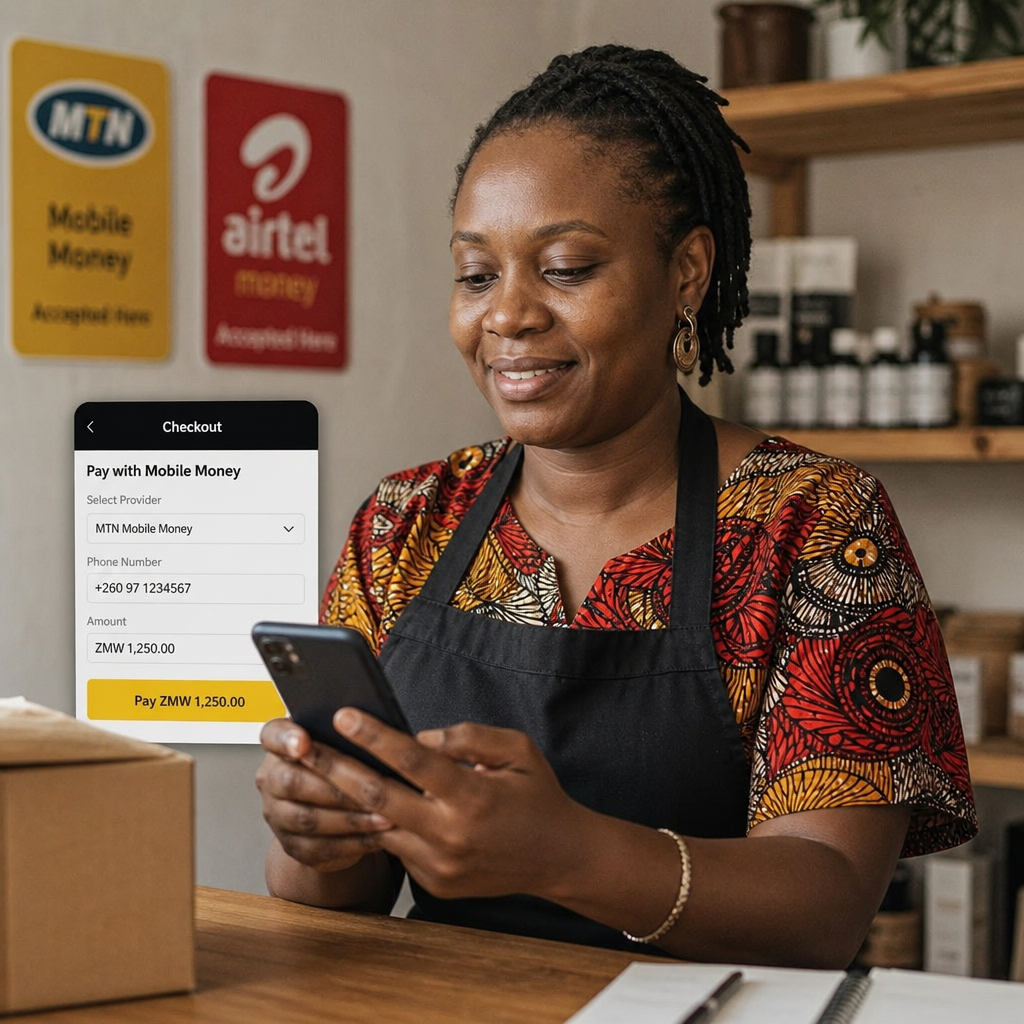
PayChangu is the gateway I recommend as a first integration for most Zambian e-commerce businesses. It is built specifically for the Zambian market and handles MTN Mobile Money, Airtel Money, and Visa/Mastercard card payments in a single integration – which matters enormously for Zambian SMBs because a large share of your customers will prefer mobile money over cards.
PayChangu’s transaction fee structure (based on published rates) is approximately 2.5% per transaction for card payments and a flat fee structure for mobile money transactions. Confirm current rates directly with PayChangu before you finalise your budget, as fees are subject to change. Integration into Shopify or WooCommerce requires a developer and typically costs ZMW 2,500 to ZMW 5,000 as part of a larger project.
Mobile Money Activation: Step-by-Step
If you want to accept MTN Mobile Money directly through your online store, here is what the activation process looks like:
- Gather your documents first. You will need your Certificate of Incorporation, TPIN (Tax Payer Identification Number), and a business bank account statement. Having these ready before you apply saves weeks.
- Visit the MTN Zambia Business portal or your nearest MTN Business branch. Request a Mobile Money API merchant account. The branch in Lusaka’s Cairo Road area handles business accounts, though regional branches can process applications too.
- Submit your application. MTN reviews business registration, TPIN validity, and the nature of your business. Approval typically takes 2 to 6 weeks. Do not start building your payment integration before approval arrives – the API credentials you receive at the end of this process are what your developer will use.
- Receive your API credentials. Once approved, MTN provides a merchant ID and API key. Share these securely with your developer.
- Developer integrates and tests. Your developer will wire up the API, run test transactions, and confirm the money settles correctly to your account.
For Airtel Money, a similar business merchant application process applies through the Airtel Zambia business portal or their head office in Lusaka. Budget for this process to run in parallel with your MTN application.
5. Delivery Rules and Fulfilment Logic
Shipping configuration is often underestimated in e-commerce budgets. A store that ships only within Lusaka at a flat rate is straightforward to configure. A store that calculates shipping by zone (Lusaka vs. Copperbelt vs. rural provinces), product weight, and courier partner – and integrates with a courier API – is a different project entirely.
Basic flat-rate shipping setup costs ZMW 500 to ZMW 1,500. Zone-based shipping with courier integration can add ZMW 5,000 to ZMW 15,000. If you are working with a third-party logistics provider, ask your developer about webhook-based order syncing, which pushes orders automatically to the courier’s system.
6. ERP and Inventory Connections
Businesses already using accounting software like Sage, QuickBooks, or a local ERP often want their online store to sync inventory and orders automatically. This prevents overselling and reduces manual data entry.
Connecting an e-commerce platform to an ERP is a significant technical task. Budget ZMW 15,000 to ZMW 35,000 for a bi-directional sync integration, depending on the ERP system and the API documentation available. Some older Zambian ERP systems have limited APIs, which requires custom middleware and increases cost further.
7. Multilingual Content
Most Zambian e-commerce sites operate in English only, which keeps costs down. If your target market includes speakers of Bemba, Nyanja, or Tonga, or if you sell across borders into DRC, Zimbabwe, or Tanzania, multilingual support becomes a genuine consideration.
Adding a second language to Shopify using an app like Weglot costs approximately USD 15 to USD 49 per month (ZMW 340 to ZMW 1,100). Custom multilingual builds on WooCommerce using WPML or Polylang add ZMW 3,000 to ZMW 8,000 in setup costs.
8. Website Maintenance Cost
Website maintenance cost in Zambia is a recurring line that many first-time store owners forget to budget for. Once your site is live, it needs updates, security patches, plugin/app upgrades, and occasional content changes.
Expect to pay ZMW 1,500 to ZMW 5,000 per month for ongoing maintenance from a local agency, or ZMW 500 to ZMW 1,500 per month if you hire a freelancer for basic upkeep. If you can manage content updates yourself, you can reduce this cost significantly – Shopify’s admin interface is designed for non-technical users.
Domain and Hosting Costs in Zambia
These are the baseline costs every online store pays, regardless of platform or features.
- Domain name (.com): ZMW 300 to ZMW 500 per year. A .co.zm domain costs a similar amount and signals a Zambian business to local customers.
- Web hosting (for WooCommerce): ZMW 500 to ZMW 2,000 per month for a reliable shared or VPS plan on a South African or local host. Cheaper plans exist but often have slow load speeds, which directly harms conversion rates.
- Shopify subscription: USD 29 to USD 299 per month (ZMW 650 to ZMW 6,700 approximately) depending on the plan. Shopify hosting is included in this fee.
- SSL certificate: Free on most platforms (Shopify includes it; Let’s Encrypt provides free SSL for WooCommerce). Some hosts charge ZMW 200 to ZMW 800 per year for premium SSL.
Mobile Checkout: A Developer Checklist
Mobile devices account for the majority of e-commerce traffic in Zambia. A checkout that works poorly on a smartphone will cost you sales. The following checklist is for developers and business owners reviewing a new build before launch:
- All form fields use the correct mobile keyboard type (numeric for phone numbers, email for email fields)
- Buttons are at least 44px tall and spaced to avoid mis-taps
- Checkout completes in three steps or fewer on mobile
- Mobile Money payment option appears as the first or second option in the payment selector
- Order confirmation SMS is sent immediately after purchase (not just email)
- Page load time on a 3G connection is under five seconds – test with Google PageSpeed Insights
- Address fields accommodate Zambian address formats (area, town, province – not all stores need a strict postcode)
ZRA Compliance: VAT Registration and Invoice Requirements
If your e-commerce business generates turnover above ZMW 800,000 per year, you are required to register for VAT with the Zambia Revenue Authority (ZRA). Once registered, your invoices and receipts – including those generated automatically by your online store – must display your VAT number and show VAT as a separate line item.
Ask your developer to configure tax settings in your platform to handle VAT correctly from day one. Shopify has a tax configuration section under Settings. WooCommerce has a tax module that can be set to Zambian rates. Getting this wrong creates accounting headaches later. For specific compliance advice, consult a Zambian tax professional or refer directly to the Zambia Revenue Authority website.
Feature Comparison Table: Starter vs. Growth vs. Enterprise
Use this table to understand what you get at each price point before you finalise your brief with a developer.
- Product catalogue: Starter (up to 50 products) / Growth (50-500 products) / Enterprise (unlimited, with variants and bundles)
- Design: Starter (pre-built template) / Growth (customised template) / Enterprise (fully custom UI)
- Payment gateways: Starter (PayChangu – mobile money + cards) / Growth (PayChangu + bank transfer + possibly Flutterwave) / Enterprise (multiple gateways, split payments, subscription billing)
- Inventory management: Starter (manual, in-platform) / Growth (basic automated alerts) / Enterprise (ERP sync, multi-warehouse)
- Shipping: Starter (flat rate) / Growth (zone-based, courier integration) / Enterprise (real-time rates, third-party logistics)
- Multilingual: Starter (English only) / Growth (optional add-on) / Enterprise (built-in)
- SEO setup: Starter (basic meta tags) / Growth (full on-page SEO) / Enterprise (structured data, schema markup)
- Analytics: Starter (Google Analytics basic) / Growth (GA4 + conversion tracking) / Enterprise (custom dashboards, BI tools)
- Maintenance: Starter (self-managed or freelancer) / Growth (agency retainer) / Enterprise (dedicated support SLA)
- Indicative one-time cost: Starter (ZMW 10,000 – 25,000) / Growth (ZMW 25,000 – 55,000) / Enterprise (ZMW 55,000 – 80,000+)
Choosing the Right E-commerce Platform for Zambia
Shopify is the platform I see working best for most Zambian businesses starting their first online store. The reason is operational simplicity: you do not manage hosting, the admin interface is approachable for non-technical owners, and the Shopify App Store gives you access to payment, shipping, and marketing tools without custom development.
WooCommerce is the better choice if you already have a WordPress website, if you have an in-house developer, or if long-term platform fees are a concern. It is also more flexible for unusual catalogue structures – useful for businesses selling configurable products like furniture or bespoke clothing.
For businesses that need deep integrations with local systems or have regulatory requirements around data hosting, a custom build remains on the table – but it should be the last resort rather than the first choice. Learn more about how Shopify and WooCommerce compare for growing businesses before making your final platform decision.
Total Cost of Ownership: A 12-Month View
The one-time setup cost is only part of the picture. Here is what a Growth-tier store on Shopify might actually cost over its first 12 months, using mid-range estimates:
- One-time development and setup: ZMW 35,000
- Shopify Basic plan (12 months at ~ZMW 650/month): ZMW 7,800
- Domain name: ZMW 400
- PayChangu integration (one-time): ZMW 3,500
- Paid Shopify apps (email marketing, reviews, etc.): ZMW 3,600
- Monthly maintenance (freelancer, 12 months at ZMW 1,000/month): ZMW 12,000
- Estimated 12-month total: ZMW 62,300
This does not include marketing spend (Google Ads, Meta Ads, WhatsApp campaigns), photography, or logistics costs. Build those into your business plan separately. For a practical guide on budgeting your first e-commerce marketing campaign, that is a good next read after this article.
How to Get an Accurate Quote from a Zambian Developer
The quality of a developer’s quote depends entirely on the quality of your brief. Before you reach out to any agency or freelancer, prepare the following information:
- Number of products and their complexity (do they have size/colour variants? Will you upload them yourself or need the developer to do it?)
- Your preferred platform (Shopify, WooCommerce, or open to recommendation)
- Payment methods you need to accept (mobile money only, cards only, or both)
- Shipping zones and courier partners you plan to use
- Any existing systems you need to connect (accounting software, POS, inventory system)
- Design preference (template with your branding, or fully custom)
- Your timeline and whether you have existing brand assets (logo, colours, fonts)
A developer who asks you these questions before quoting is a good sign. One who gives you a price without asking is likely to increase it later via change requests.
Key Takeaways
- E-commerce website cost in Zambia starts at ZMW 10,000 for a basic starter store as a one-time setup fee – monthly platform and hosting fees are additional.
- Stripe is not available in Zambia. PayPal cannot settle to a Zambian bank account. Paystack is not operational in Zambia. Do not design your payment architecture around these tools.
- PayChangu is the recommended first payment gateway for Zambian businesses – it covers MTN Mobile Money, Airtel Money, and cards in one integration.
- Mobile Money API approval from MTN or Airtel takes 2 to 6 weeks. Start the application process before you start building.
- If your annual turnover exceeds ZMW 800,000, you must register for VAT with the ZRA and configure your store to display VAT correctly on all invoices.
- Budget for 12-month total cost of ownership, not just the one-time build cost. Maintenance, platform subscriptions, and apps add up quickly.
- Provide a detailed brief before requesting quotes – the specificity of your brief directly determines the accuracy of the price you receive.
Ready to Build Your Online Store in Zambia?
Getting an accurate quote for your specific store starts with a conversation. Whether you are weighing Shopify against WooCommerce, trying to figure out how to integrate mobile money, or scoping a full ERP connection, the right developer will walk you through the options before you commit to anything.
Explore our e-commerce development services to see how we work with businesses at every stage – from first-time sellers to established retailers scaling online. Or request a tailored quote and we will come back to you with a breakdown specific to your product, platform, and payment requirements.
FAQ
How much does an e-commerce website cost in Zambia for a small business?
A starter e-commerce website in Zambia costs between ZMW 10,000 and ZMW 25,000 as a one-time setup fee. This typically covers template-based design, up to 50 products, basic payment integration (such as PayChangu for mobile money and cards), and a mobile-responsive layout. Monthly hosting and platform fees of ZMW 500 to ZMW 2,000 are additional.
Which payment gateway works best for an online store in Zambia?
PayChangu is the recommended gateway for most Zambian online stores. It supports MTN Mobile Money, Airtel Money, and Visa/Mastercard cards through a single integration. Stripe does not support Zambia, PayPal cannot settle funds to a Zambian bank account, and Paystack is not operational in Zambia. Start your MTN merchant application early – approval takes 2 to 6 weeks.
Is Shopify a good platform for e-commerce in Zambia?
Yes, Shopify is a strong choice for most Zambian businesses launching their first online store. It is hosted (so no separate server costs), has an approachable admin interface, and works well with PayChangu for local payment processing. The main ongoing cost is the monthly subscription, starting at approximately USD 29 per month (around ZMW 650 at current rates).
Do I need to register for VAT in Zambia if I sell online?
VAT registration with the Zambia Revenue Authority (ZRA) is required once your annual business turnover exceeds ZMW 800,000. Once registered, your online store must display your VAT number and show VAT as a separate line item on all invoices and receipts. Configure this in your platform's tax settings from the start to avoid compliance issues later.
How long does it take to build an e-commerce website in Zambia?
A starter template-based store typically takes 2 to 4 weeks to build once the developer has all assets (logo, product images, copy, and payment credentials). A Growth-tier store with custom design and courier integration takes 6 to 10 weeks. Allow an additional 2 to 6 weeks if you are waiting for Mobile Money API approval from MTN or Airtel – this process should run in parallel with development.
What ongoing costs should I budget for after my online store launches?
Plan for Shopify subscription fees (ZMW 650 to ZMW 6,700 per month depending on plan), domain renewal (ZMW 300 to ZMW 500 per year), maintenance (ZMW 500 to ZMW 5,000 per month), paid apps or plugins, and marketing spend. A mid-range Shopify store typically costs ZMW 50,000 to ZMW 65,000 in total during its first 12 months when setup and running costs are combined.
Can I build a cheap e-commerce website in Zambia myself?
Yes, platforms like Shopify allow non-technical users to set up a basic store without a developer, though you will still pay the monthly subscription fee. The challenge for most Zambian businesses is payment gateway integration – connecting PayChangu or Mobile Money APIs requires developer knowledge. A hybrid approach works well: hire a developer for setup and payment integration, then manage content yourself.