The WordPress vs custom website debate is the first real decision most business owners face when building their online presence, and getting it wrong costs time, money, and customers. I’ve worked with Zambian businesses ranging from Lusaka-based freight companies to Ndola retail shops, and the choice between WordPress and custom development consistently shapes whether a project succeeds or stalls.
WordPress powers 43.4% of all websites on the internet, according to W3Techs data from early 2025, giving it a 62.7% share of the CMS market. That dominance is real, but it does not mean WordPress is the right answer for every business. Custom development solves problems that no plugin can fix.
This guide breaks down both options across cost, timeline, flexibility, scalability, security, maintenance, and ownership. You will also find a Zambia-specific decision table, real payment gateway guidance, and ZMW pricing estimates so you can make a grounded decision before spending a single kwacha.
What WordPress Actually Is (and Is Not)
WordPress is an open-source content management system (CMS) that lets you build and manage websites without writing code from scratch. You install it on a hosting server, choose a theme for the visual design, and add plugins to extend functionality. The core software is free.
What WordPress is not is a silver bullet. It handles roughly 90% of standard use cases well: blogs, brochure sites, service pages, portfolios, and straightforward e-commerce. The moment your project requires real-time APIs, a custom database schema, proprietary business logic, or deeply integrated third-party systems, WordPress starts showing its limits and often becomes a liability rather than an asset.
What Custom Website Development Actually Means
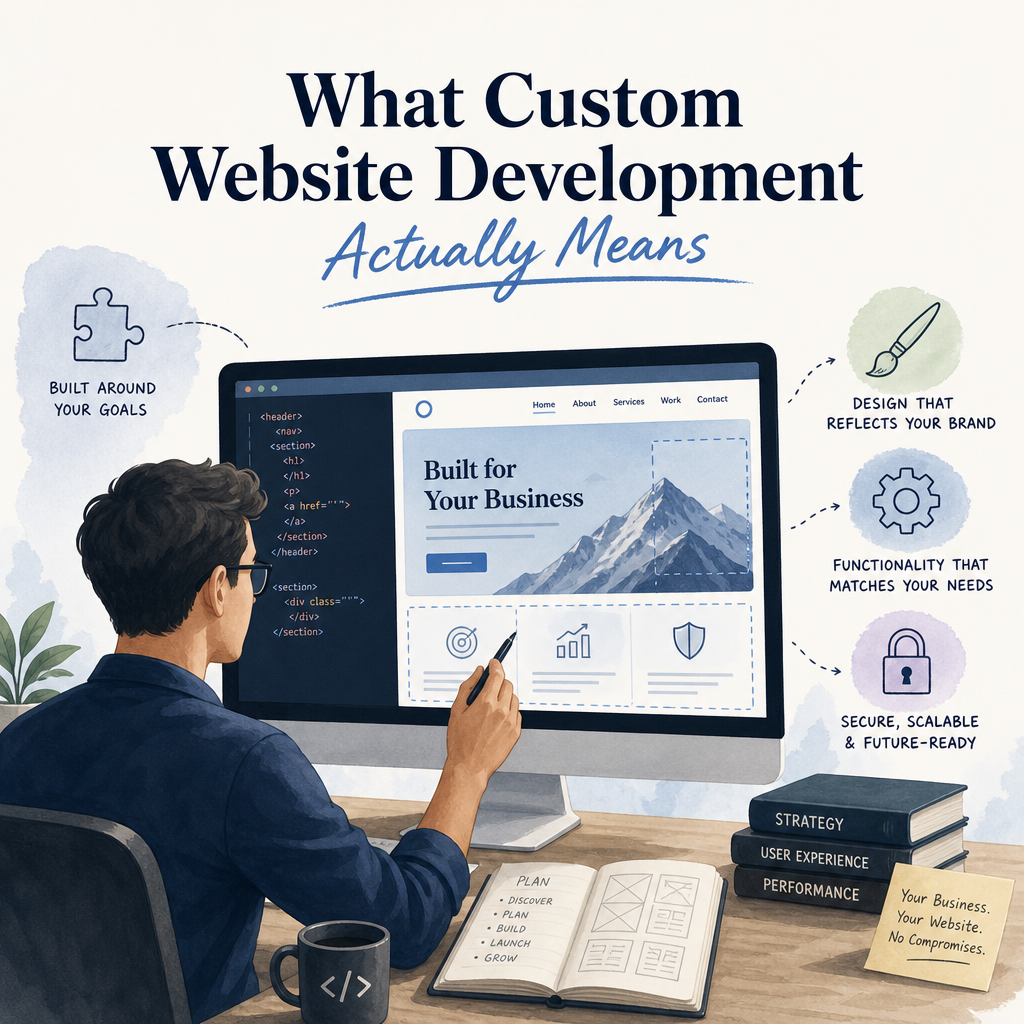
Custom development means a developer (or team) builds your website from the ground up using a programming language such as PHP, Python, Node.js, or React. There is no pre-built CMS underneath unless you want one. Every feature, every database table, every user flow is built specifically for your business requirements.
Custom does not automatically mean better. It means purpose-built. A custom freight-matching platform is right for Zambia Cargo Connect. A custom website for a three-page dental clinic in Lusaka is almost certainly overkill and a waste of budget that could go toward marketing.
Cost Comparison: WordPress vs Custom Website Development
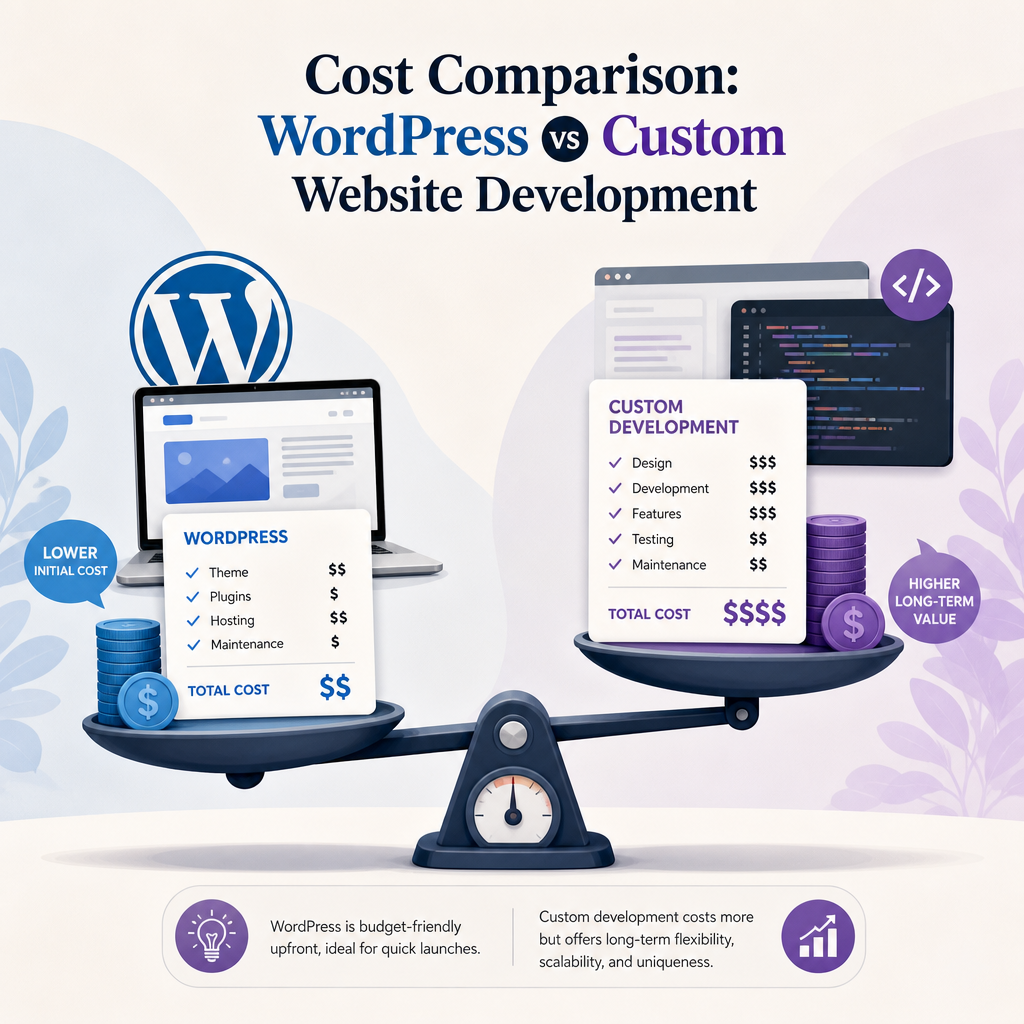
Cost is usually the first question, so let’s make it concrete. All USD figures include approximate ZMW equivalents at a rate of roughly ZMW 26 per USD as of mid-2025. Note that the kwacha is subject to exchange-rate volatility, so confirm current rates before budgeting.
WordPress Cost Breakdown
- Domain name: $10-15/year (ZMW 260-390)
- Hosting (shared, e.g., SiteGround or Bluehost): $3-15/month (ZMW 78-390). Note that SiteGround and most international hosts require a USD-capable Visa or Mastercard. If you do not have one, regional alternatives like Cyon Africa or Afrihost accept local payment methods and offer closer data-centre latency for Southern African visitors.
- Premium theme: $50-100 one-time (ZMW 1,300-2,600)
- Essential plugins (SEO, security, forms, caching): $80-200/year (ZMW 2,080-5,200)
- WordPress developer setup fee (Zambia market): $300-800 (ZMW 7,800-20,800)
- Ongoing maintenance and updates: $50-150/month (ZMW 1,300-3,900)
Realistic first-year total for a WordPress site: $600-1,800 (ZMW 15,600-46,800)
The Hidden Cost Problem with WordPress – A Worked Example
The headline cost looks attractive, but I’ve watched WordPress projects balloon in ways that surprised the client. Here is a realistic itemisation for a mid-sized Zambian e-commerce store built on WooCommerce:
- WooCommerce base plugin: free
- WooCommerce Subscriptions (if you need recurring billing): $279/year (ZMW 7,254)
- WooCommerce Bookings (for appointment scheduling): $249/year (ZMW 6,474)
- Security plugin premium tier (Wordfence Premium): $119/year (ZMW 3,094)
- Performance/CDN plugin: $99/year (ZMW 2,574)
- Developer cleanup after a plugin conflict: $150-400 one-time (ZMW 3,900-10,400)
- Emergency patch after a theme update breaks layout: $100-250 one-time (ZMW 2,600-6,500)
Add these up and your “cheap” WordPress store costs an extra $1,000-1,300/year (ZMW 26,000-33,800) beyond the base estimate. Compare that against a custom-built store with no annual plugin licensing, and the gap narrows considerably by year two.
Custom Development Cost Breakdown
- Discovery and architecture planning: $500-1,500 (ZMW 13,000-39,000)
- Design (UI/UX): $800-3,000 (ZMW 20,800-78,000)
- Development (frontend + backend): $2,000-15,000+ (ZMW 52,000-390,000+)
- Testing and QA: $300-1,000 (ZMW 7,800-26,000)
- Server setup and deployment: $200-500 (ZMW 5,200-13,000)
- Ongoing hosting (VPS or cloud): $20-100/month (ZMW 520-2,600)
Realistic first-year total for a custom site: $4,000-20,000+ (ZMW 104,000-520,000+)
The custom route costs significantly more upfront. But by year three, a custom system with no plugin licensing and predictable maintenance costs can match or beat the total cost of ownership for a heavily-plugged WordPress installation.
Timeline: How Long Does Each Option Take?
WordPress
- Simple brochure site (5-8 pages): 1-2 weeks
- Business site with blog and contact forms: 2-4 weeks
- WooCommerce store (standard products): 3-6 weeks
Custom Development
- Simple custom site (no complex logic): 4-8 weeks
- Custom e-commerce or booking platform: 3-6 months
- Complex web application (APIs, dashboards, real-time data): 6-18 months
For Zambian businesses launching ahead of a seasonal campaign, like the Christmas retail spike or the start of the farming season, WordPress is often the only practical choice on a tight timeline. Custom development is a medium-to-long-term investment.
Flexibility and Customization
WordPress is genuinely flexible for standard requirements. Need a gallery, a booking calendar, a membership area, or a multi-currency product catalogue? There is a plugin for each. The constraint appears when your requirements fall outside standard patterns.
Custom development has no such ceiling. You define the rules. A Zambian freight company that needs to match trucks to loads in real time, track GPS waypoints, and auto-generate invoices in ZMW cannot achieve that cleanly with WordPress plugins. That system needs a custom database schema, a real-time communication layer, and business logic that no plugin ships.
A practical rule of thumb: if you can describe your feature and find a WordPress plugin that does exactly that within 10 minutes of searching, WordPress probably fits. If you are describing something and the developer keeps saying “we can approximate that,” you are in custom territory.
Scalability
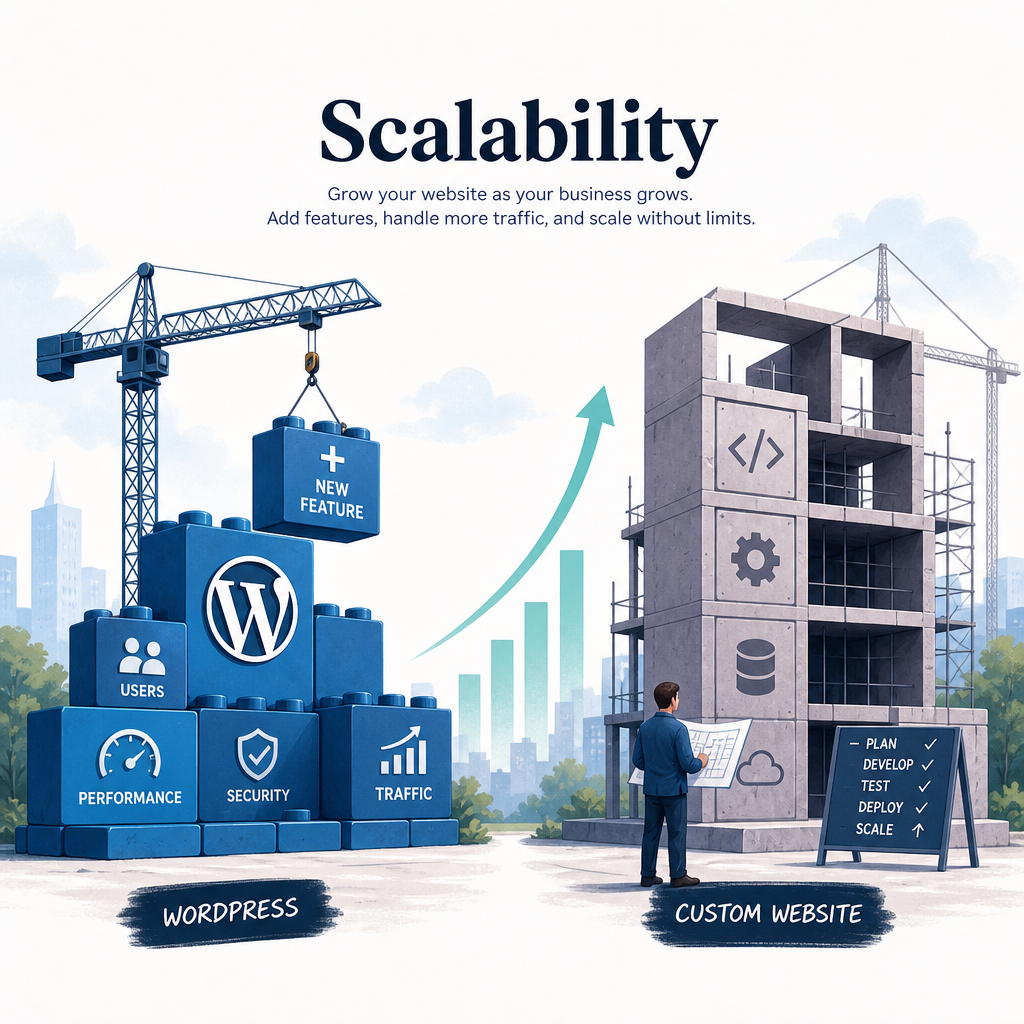
WordPress scales reasonably well with the right hosting stack. A WooCommerce store on a managed cloud host (like Kinsta or WP Engine) can handle thousands of orders per day. The bottleneck is usually database architecture: WordPress uses a generic post-meta storage model that works fine until you have complex relational data or very high query volumes.
Custom-built systems are architected for your specific load profile from day one. If you know your platform will handle 50,000 transactions per month with complex financial reporting, a custom database schema will outperform WordPress significantly at that scale.
For most Zambian SMEs at current growth trajectories, WordPress is not the scalability bottleneck. The bottleneck is usually internet infrastructure, payment gateway uptime, or marketing budget. Build for where you are going in the next two years, not the next ten.
Security
WordPress’s popularity makes it a high-value target. Because 43%+ of the web runs WordPress, attackers build automated tools specifically for it. Vulnerable plugins, outdated themes, and weak passwords are the three most common entry points I see in compromised Zambian business sites.
This does not mean WordPress is insecure. It means security requires active management: keep core, plugins, and themes updated, use a web application firewall (Wordfence or Cloudflare), enforce strong passwords, and back up daily. A neglected WordPress installation is a security liability. A well-maintained one is genuinely safe for most business needs.
Custom-built sites are not inherently more secure; they are simply less of a target for automated attacks. A custom site with poorly written authentication code is far more dangerous than a well-configured WordPress site. Security is about implementation discipline, not the platform label.
Maintenance
WordPress requires regular attention: core updates, plugin updates, theme updates, database optimisation, and periodic security scans. Expect 2-4 hours of maintenance per month on a typical business site, or a monthly retainer with a WordPress developer in Zambia of around $50-150 (ZMW 1,300-3,900).
Custom sites have lower routine maintenance overhead because there are no third-party plugins releasing weekly updates. But when something breaks or a feature needs changing, you need the original developer or someone who can read the codebase. The risk is vendor lock-in to a specific developer rather than a generic platform.
Ownership and Portability
With WordPress, you own your content and your data. The open-source software means you can move hosts, switch developers, or migrate platforms at any time. Your content is stored in a standard MySQL database and can be exported. This is a genuine advantage.
With custom development, ownership depends entirely on your contract. Before any custom project starts, your agreement should state clearly: you own the source code, you receive access to the code repository (GitHub or GitLab), and the developer cannot hold the codebase hostage if the relationship ends. If a Zambian developer quotes you a custom site but refuses to hand over the source code at completion, walk away.
Zambia-Specific Consideration: Payment Gateways
This is the section most comparison articles skip, and it directly affects whether your Zambian e-commerce site actually works for local customers.
Three payment gateways are essential to understand for the Zambian market:
- DPO Pay (formerly 3G Direct Pay): Supports MTN Mobile Money, Airtel Money, Visa, and Mastercard. Has an official WooCommerce plugin. This is the most commonly recommended gateway for Zambian WooCommerce stores.
- Pesapal: Supports mobile money and card payments across East and Southern Africa. Has a WooCommerce integration and is widely used by Zambian NGOs and SMEs.
- PayChangu: A newer Zambian-founded gateway with MTN MoMo and Airtel Money support. Their WooCommerce plugin is actively maintained and worth evaluating for local-first stores.
If you are building on WordPress with WooCommerce, confirm that your chosen gateway has an active, up-to-date WooCommerce plugin before you commit to a theme or layout. Some premium themes have checkout flows that conflict with third-party payment plugins. Test this in a staging environment before going live.
For custom development, all three gateways provide REST APIs. A competent developer can integrate any of them into a custom-built checkout. The advantage of custom here is that you are not constrained by plugin compatibility or WooCommerce’s checkout structure.
For MTN MoMo and Airtel Money specifically, DPO Pay and PayChangu are the most reliable WooCommerce-compatible options as of mid-2025. Always check the gateway’s official documentation for current Zambia support, as coverage changes.
Decision Table: WordPress vs Custom Website
Use this table to map your situation to the right recommendation:
Choose WordPress when:
- Budget is under $2,000 (ZMW 52,000)
- You need the site live within 4-6 weeks
- Your functionality is covered by existing plugins (blog, standard e-commerce, booking forms, membership)
- You want to manage content yourself without a developer on call
- You are testing a business idea before committing to a larger build
- Your team is non-technical and needs a familiar CMS interface
Choose custom development when:
- You need real-time data processing (live inventory, GPS tracking, live pricing)
- Your business logic is proprietary and cannot be replicated by a plugin
- You require a custom database schema (complex relational data, multi-tenant architecture)
- You are integrating deeply with third-party Zambian government or enterprise systems
- You expect very high transaction volumes that will strain WordPress’s generic database structure
- You have a budget above $5,000 (ZMW 130,000) and a timeline of 3+ months
- Long-term total cost of ownership matters more than upfront savings
Zambia Business Scenarios: A Decision Tree
Scenario 1: Lusaka Retail Shop Moving Online
You sell clothing and accessories from a physical shop in Levy Mall and want to add an online store. You have 200 products, accept MTN MoMo and Airtel Money, and your nephew handles social media. You need this done within six weeks ahead of the festive season.
Recommendation: WordPress + WooCommerce. Use DPO Pay or PayChangu for mobile money. Budget ZMW 20,000-40,000 for setup. Your functionality is standard, your timeline is tight, and WordPress will serve you well for years if maintained.
Scenario 2: Ndola Freight Company with a Matching Platform
You want to build a platform where truck owners list available capacity and businesses post loads. The system needs real-time notifications, GPS input fields, automated pricing calculations, and ZMW invoicing with PDF generation. You have a $10,000 (ZMW 260,000) budget and a six-month runway.
Recommendation: Custom development. WordPress cannot cleanly handle real-time matching logic or a custom relational database for trucks, loads, and routes. A custom Node.js or Laravel backend with a React frontend is the right architecture. Integrate DPO Pay’s REST API for payments. Prioritise finding a developer who will hand over the full source code.
Scenario 3: Livingstone Tourism Operator
You run boat tours and need a booking system with date selection, party size, add-ons (meals, transfers), and online payment. You want to manage bookings from a simple dashboard and send confirmation emails automatically.
Recommendation: WordPress + WooCommerce Bookings or a plugin like Amelia. This is exactly the use case these tools were built for. The functionality is standard, the plugins are mature, and you will have a working system in 3-4 weeks. Budget ZMW 25,000-55,000 including plugin licenses.
Scenario 4: Zambian Fintech Startup
You are building a micro-lending product where users apply via mobile, get a credit score from a local bureau API, receive a loan decision in under 60 seconds, and repay via MTN MoMo. You have seed funding and a 12-month development runway.
Recommendation: Custom development, full stop. This is not a WordPress project by any definition. It requires custom API orchestration, a secure financial data model, regulatory compliance logic, and a mobile-first UX that a CMS theme cannot deliver. Hire a team, not a WordPress developer.
WordPress Pros and Cons Summary
Pros
- Low upfront cost and fast launch timeline
- Large ecosystem of themes and plugins
- Non-technical users can manage content without developer help
- Open-source: you own your data and can move hosts freely
- Strong community support and documentation
- WooCommerce integrates with DPO Pay, Pesapal, and PayChangu for Zambian payments
Cons
- Plugin costs and conflicts add up over time
- Generic database architecture limits performance at high scale
- High-profile target for automated attacks
- Customisation beyond plugin capabilities requires significant developer work
- Theme updates can break your layout unexpectedly
Custom Development Pros and Cons Summary
Pros
- Built precisely for your requirements with no compromise
- Optimised performance and database architecture
- No plugin licensing fees or third-party dependency conflicts
- Purpose-built security model
- Scales on your terms, not a CMS’s architecture
Cons
- High upfront cost and longer development timeline
- Requires a skilled developer for every change
- Risk of vendor lock-in if source code ownership is not contracted clearly
- No community ecosystem of pre-built add-ons
- Poor choice for content-heavy sites that need non-technical editing
Key Takeaways
- WordPress handles roughly 90% of standard business website requirements. If your needs fall within that range, it is the faster and cheaper path to launch.
- Custom development is the right answer when your business logic is proprietary, your data model is complex, or you need real-time systems that no plugin supports.
- In Zambia, payment gateway compatibility is non-negotiable. Confirm DPO Pay, Pesapal, or PayChangu integration before finalising your theme or tech stack.
- Hidden WordPress costs (plugin licensing, developer cleanup, emergency patches) can add ZMW 26,000-33,800 per year to the apparent base cost.
- Always secure source code ownership in writing before a custom development project begins.
- International hosts require USD-capable cards. Cyon Africa and Afrihost are viable regional alternatives for Zambian businesses without international payment access.
- Budget in ZMW but plan for exchange-rate movement. The kwacha has historically been volatile against the USD.
Conclusion
There is no universally correct answer to the WordPress vs custom website question. The right answer depends entirely on your business requirements, your budget, your timeline, and how much of your competitive advantage lives in proprietary logic that no plugin can replicate.
For most Zambian SMEs in retail, tourism, services, or straightforward e-commerce, WordPress with WooCommerce is the practical, cost-effective starting point. Set it up properly, integrate a local payment gateway, and invest the savings into marketing. You can always migrate features to a custom system later when revenue justifies it.
For businesses building platforms, fintech products, or systems with real-time complexity, custom development is not a luxury. It is the only architecture that will actually work.
If you are still unsure which path fits your business, explore our website development services for Zambian businesses or read our guide on setting up an e-commerce store in Zambia. You can also browse how to hire a WordPress developer in Zambia for a step-by-step vetting process.
Drop your specific use case in the comments below and I will point you toward the right stack.
FAQ
Is WordPress good enough for a Zambian e-commerce store?
Yes, for most Zambian e-commerce stores. WordPress with WooCommerce handles product catalogues, shopping carts, and checkout well. Pair it with DPO Pay, Pesapal, or PayChangu for MTN MoMo and Airtel Money support. Confirm your chosen payment gateway has an active WooCommerce plugin before committing to a theme.
How much does a custom website cost in Zambia compared to WordPress?
A WordPress site typically costs ZMW 15,600-46,800 in the first year. A custom-built site starts around ZMW 104,000 and can exceed ZMW 520,000 for complex platforms. By year three, hidden WordPress plugin and maintenance costs can narrow that gap significantly for feature-heavy builds.
Can I switch from WordPress to a custom website later?
Yes, you can migrate content and rebuild on a custom stack, though it requires time and budget. Many businesses start on WordPress to validate their idea, then move to custom development once revenue and requirements justify it. Export your content early and keep your database backed up to make migration easier.
Which payment gateways work with WordPress WooCommerce in Zambia?
DPO Pay, Pesapal, and PayChangu all offer WooCommerce plugins compatible with Zambian payment methods including MTN MoMo and Airtel Money. DPO Pay is the most widely used. Always check the plugin's last update date and test it in a staging environment before going live.
When should I choose custom website development over WordPress?
Choose custom development when your project needs real-time APIs, a proprietary database schema, complex matching or financial logic, or deep integration with enterprise systems. If you cannot find a WordPress plugin that does exactly what you need within 10 minutes of searching, you are likely in custom-development territory.
What hosting options exist for Zambian businesses that do not have international payment cards?
International hosts like SiteGround and Bluehost require USD-capable Visa or Mastercard. If you do not have one, Cyon Africa and Afrihost are regional hosting alternatives that accept local payment methods and offer data centres closer to Southern African users, which improves site speed for local visitors.
Is WordPress secure enough for a business website?
WordPress is secure when properly maintained. The main risks are outdated plugins, weak passwords, and neglected updates. Use a web application firewall like Wordfence or Cloudflare, update core and plugins regularly, and back up your site daily. A well-maintained WordPress site is safe for the vast majority of business applications.